Author: faystephenson

  • Farmhouse Friday – Family Bathroom

    Farmhouse Friday – Family Bathroom

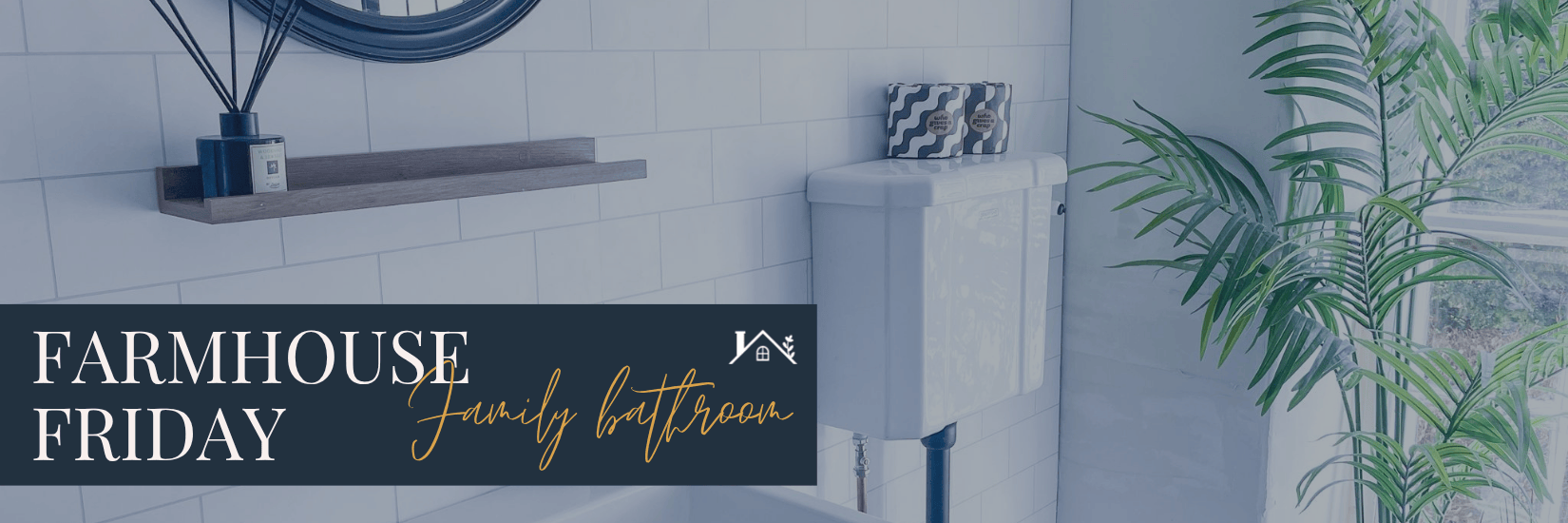
    Introducing my brand new series of Farmhouse Friday, where I’ll share a specific room within the house, and what’s happened this last week. The first room of the series is the family bathroom, which is pretty much done. It’s not been without its challenges; a Victorian farmhouse bathroom isn’t always straightforward. So check out the before and after, and how we managed to do this for less than £2.5k! I will caveat from the outset that the wall panels we used were kindly #gifted from Multipanel.

    Farmhouse Friday - Victorian farmhouse bathroom before and after (4)

    The room itself isn’t small as such, but does come with some limitations. It was originally part of a much larger room, hence the stunning, large window. However, this doesn’t immediately lend itself to a bathroom. Not only that, but it is long and thin, making it difficult to change any layout with great effect. And let’s not mention the 70’s pine cladding…

    Originally, there had been a bath, basin and toilet, and the layout wasn’t going to change. However, with 3 boys, we wanted to go for a large shower, rather than a bath. I also knew this would probably be the most used bathroom, so it needed to be easy to keep clean, too!

    A monochrome bathroom to me is timeless, and perfect to pick up/refresh with simple highlights if wanted. I did feel it would be very stark on its own, and so wanted to ensure some greenery was added to soften the look. The renovation itself was fairly straightforward, although we did come across a few hiccups.

    • The layout was already there, so no major work was required.
    • The window added a fantastic amount of natural light.
    • The panelling was pretty easy to install and went up in a day.
    • There was a small misunderstanding around the wall-hung basin, which means the plumber had to cut out the panelling once it had been installed. He very kindly cut out along the ‘grout’ of the tiles, so once back in place, it should be unnoticeable.
    • The window gives no privacy at all.

    Here is the breakdown of exactly how much the restoration cost and where we sourced everything from.

    Wall Panels – Multipanel UK – Alpine White Metro Collection (Very kindly #gifted) – P.O.A

    Floor TilesAmazon #Aff – £127.60

    Traditional Concealed ShowerVictorian Plumbing – £249.95

    Shower Tray & Screen Victorian Plumbing – £539.95

    Wall Hung BasinVictorian Plumbing – £129.95

    Traditional Wall Mounted TapsVictorian Plumbing – £139.95

    Traditional Low Level ToiletVictorian Plumbing – £299.95

    Soft Close Toilet SeatVictorian Plumbing – £79.95

    Traditional Style RadiatorVictorian Plumbing – £419.95

    Wall LightsDunlem – £64 (£32 each)

    Mirror B&M – £8

    ShelfB&M – £5 (have linked longer size for online, but shorter length available in store)

    Japanese ScreenAmazon #Aff – £89.99 The perfect solution to the privacy issue!

    Plants – My own

    Wooden Storage Unit – My own

    Shower WasteVictorian Plumbing – £37.95

    Basin Waste & Bottle TrapVictorian Plumbing – £89.95


    So, there we have it. The first of our Farmhouse Friday series, and a deep dive into our Victorian farmhouse bathroom before and after. If you have any questions, then please just ask, and I’d love to know if you like?!

    Would you consider using wall panels instead of tiles?!

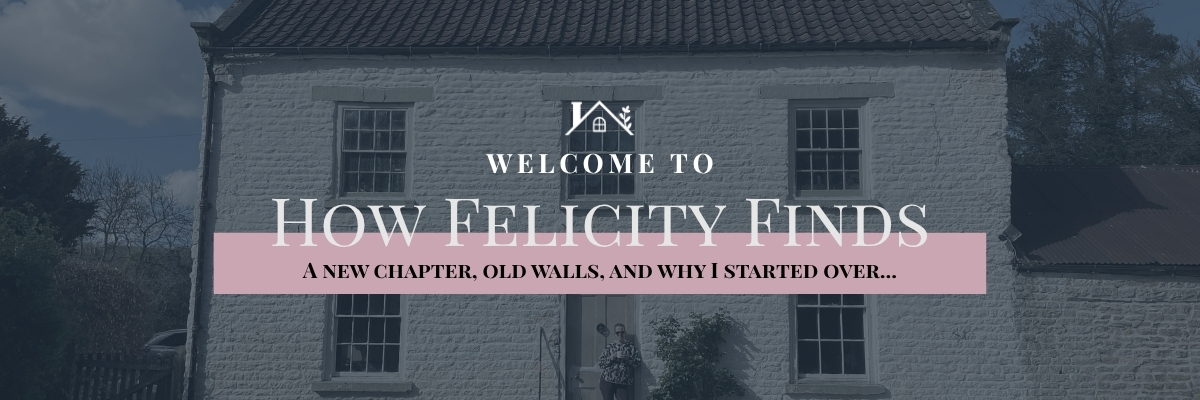
  • A new chapter, old walls, and why I started over: welcome to How Felicity Finds

    A new chapter, old walls, and why I started over: welcome to How Felicity Finds

    I’m currently standing in the chaos that is our ‘kitchen’. The floor is still to be levelled and laid, and the kitchen is due to arrive next week. I’m beginning to wonder why I decided that documenting our Victorian farmhouse renovation and rebranding was a good idea! So many women are reaching their 40s and 50s, getting diagnosed with ADHD and/or navigating menopause — and realising they can’t keep living the way they always have… so they start again. Sound familiar?

    The community I built with ADHD Menopause and Me has been amazing. My account was initially set up to support me and my kids through some pretty tough years. We went from a ‘typical’ family to an ND family with diagnoses of Dyslexia, Delayed Processing, ADHD and now Autism. All in the space of 5 years. I was trying to navigate menopause and raise awareness, but I couldn’t understand why I found it so hard. Walking alongside my boys through their diagnosis journeys taught me something unexpected. I was neurodivergent too. Suddenly, a lifetime of feelings I couldn’t explain began to make sense.

    My journey looks different now. The boys are older, and life has shifted. But you are still here — and that means everything. I can’t wait to share this next chapter with you.

    Our youngest’s move to secondary school was, in a word, hard. What we’d hoped would be a fresh start quickly revealed itself to be something more significant. His struggles were deeper and more complex than any of us had fully understood.

    Over the years that followed, getting him into school at all became the daily battle. Alongside the dyslexia and ADHD we already knew about, it became increasingly clear that he was also autistic with a PDA profile. Once we understand that, so much of what had felt confusing suddenly makes sense. But his difficulties at school were almost secondary to what was happening socially. Too trusting, too easily led, and younger than his years in ways that weren’t always visible on the surface. I watched him begin to form friendships that worried me. Find himself in situations I couldn’t always protect him from.

    It was a lot. For him, and for all of us.

    At the same time, life was shifting in other ways. Our two eldest had flown the nest, and for the first time in years, there was space. Space to breathe, to think, and to ask what came next. More than a decade earlier, we had built our first home from the ground up, and that itch had never really gone away.

    So we made a decision. A deliberate, wholehearted one. We would move somewhere rural, somewhere slower, somewhere that might give Sam a genuine fresh start in an environment that actually suited him — and give us a new project to pour ourselves into, while still being a home our boys could always come back to.


    If you’d asked me a year ago what this space was going to become, I’m not sure I could have told you. But standing in the middle of a half-finished Victorian farmhouse in North Yorkshire, covered in renovation dust with an ADHD brain running at full speed and a body doing its best impression of a malfunctioning thermostat, it became pretty clear.

    It’s the farmhouse — Hall Farm, Victorian, Grade II listed, full of original features and full of renovation challenges I absolutely did not anticipate. I’ll be sharing every step of the restoration here, the wins, the disasters, the moments where we question every decision we’ve ever made. And of course, the ones where we look at an original sash window and remember exactly why we did this.

    It’s the village — Thornton-le-Dale is the kind of place you move to and immediately wonder why you didn’t do it sooner. The beck, the countryside, the slower pace of it all. I want to share what rural life actually looks like when you swap a village just outside the busy city of York for somewhere with a slower pace, woodland in your back garden and the North Yorks Moors on your doorstep.

    It’s the ND life — I’m AuDHD and menopausal and a mum to three boys who each come with their own version of complex, and I’m not going to pretend any of that is straightforward. The real talk about neurodivergence, perimenopause, and parenting ND kids stays, because it’s part of every single day here, and it deserves to be spoken about honestly.

    And it’s the finds — the things that actually help. Products, tools, places, services that make life in this particular messy, beautiful chaos a little more manageable. Always honest, never just because I’ve been asked.

    If you’re a woman in your forties navigating a big life change — or dreaming of one — and you want company that doesn’t pretend it’s easy, you are absolutely in the right place.

    I have a lot planned, and for once, the ADHD hyperfocus is working entirely in our favour.

    Every Friday, I’ll be posting a Farmhouse Friday update — one room, one decision, one honest account of where we are with the restoration. We’re starting with the bathroom, which is the one space we’ve actually finished, and working our way through the rest of the house in real time. No staged reveals, no waiting until it’s perfect. You’re getting it as it happens.

    I’m also putting together a proper guide to Thornton-le-Dale — the walks, the places to eat, the things the locals know that don’t make it onto any tourist website. If you’ve ever thought about making a move like this, I want that guide to be the thing that helps you imagine it for yourself.

    And the AuDHD and menopause content isn’t going anywhere. In fact, I’ve got a post coming that I’ve been wanting to write for months about what executive dysfunction actually looks like when you’re also trying to manage a renovation, a family, and a rebrand simultaneously. Spoiler: it looks exactly as chaotic as you’d imagine.

    The best way to keep up is to follow along on Instagram at @how_felicity_finds, or subscribe below to get new posts straight to your inbox. No spam, no schedules — just a new post when it’s ready.


    This is a new chapter. The walls are old, the floors are (mostly) original, and I am very much a work in progress — but that’s rather the point.

    I’m glad you’re here. I hope you stay.

  • 5 Walks Around Thornton-le-Dale that Actually Calm an Overwhelmed Brain

    5 Walks Around Thornton-le-Dale that Actually Calm an Overwhelmed Brain

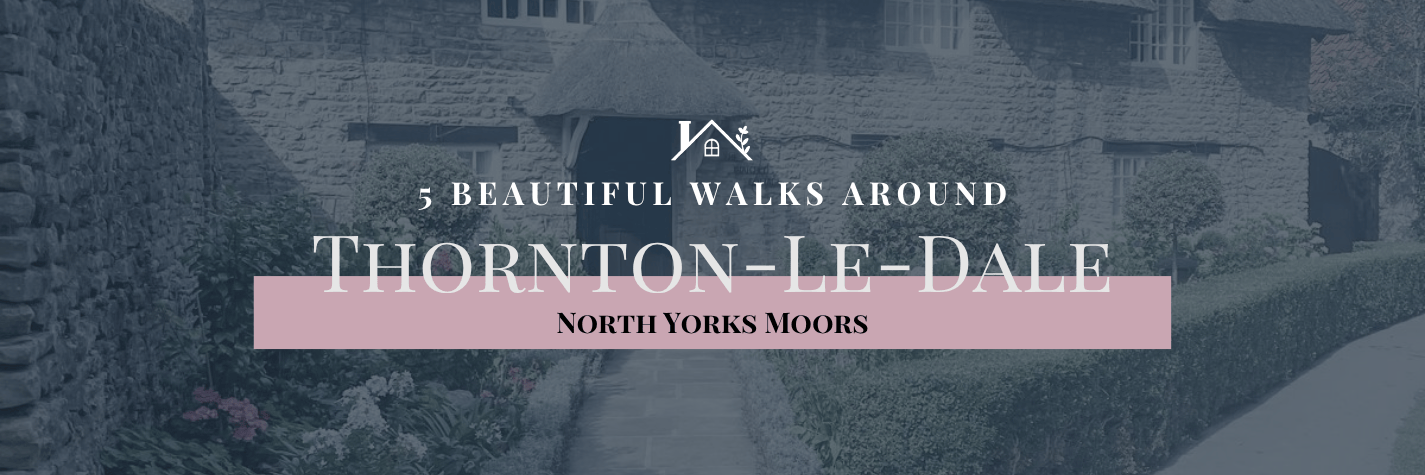
    Tucked away in the heart of the North York Moors, Thornton-le-Dale is often described as one of the prettiest villages in Yorkshire — and it’s not hard to see why. We fell in love with the village immediately and are so lucky to call it home. With its winding beck, thatched cottages, and easy access to forests, moorland and valleys, it’s the perfect base for a day of walking.

    Whether you’re after a gentle stroll (like me) or a longer countryside adventure (like my boys), here are five of my best walks around Thornton-le-Dale.


    Distance: ~5 miles
    Difficulty: Easy–Moderate
    Highlights: Thornton Beck, Ellerburn, St Hilda’s Church

    If you only do one walk, make it this one, we do it a lot with Daisy (our Dachshund). This circular route takes you out of the village along the Thornton Beck before heading towards the tiny hamlet of Ellerburn.

    Along the way, you’ll pass St Hilda’s Church, which dates back to around 1050 and even features a Viking-era cross — a real hidden gem.

    Image shows St Hilda’s Church, which dates back to around 1050 and even features a Viking-era cross

    👉 View the full route and map

    Why it’s great:
    This walk captures everything that makes the area special — water, woodland, history and open countryside.


    Distance: 7–9 miles
    Difficulty: Moderate
    Highlights: Forest trails, wildlife, valley views

    A slightly longer circular walk that heads north out of the village and into Dalby Forest — 8,000 acres of woodland.

    This moves from open countryside into shaded forest tracks, with gentle climbs and fantastic views along the way.

    👉 See detailed route info (7-mile version)

    Why it’s great:
    It’s ideal if you want a mix of scenery — peaceful woodland, birdsong, and stunning views back across Ryedale.


    Distance: ~3 km
    Difficulty: Easy (family-friendly)
    Highlights: Village green, nature reserve, thatched cottages

    If you are short on time, then this gentle loop is perfect. Starting near the village car park, the route takes you through a small nature reserve before looping around the village itself.

    The village is full of picturesque bridges, flower-filled gardens, and some of the most photographed cottages in Yorkshire.

    👉 Follow a simple route guide here

    Why it’s great:
    It’s accessible, relaxing, and perfect for families.


    Distance: ~9 miles
    Difficulty: Moderate
    Highlights: Woodland tracks, valley views, Dalby Beck

    This longer circular route is a favourite with local walkers here in the village. It follows Thornton Beck out of the village, climbs gently into woodland, and eventually reaches Low Dalby before looping back.

    This walk is a mix of forest tracks, quiet lanes and open views — with a couple of steady climbs along the way.

    👉 Find more details via the Ramblers group

    Why it’s great:
    A proper “day out” walk with varied terrain and just enough challenge to feel rewarding. Perfect to come back into the vllage and enjoy a quick pint at one of the village pubs! Or a warming coffee at one of our fab cafes & deli’s.


    Distance: ~12 miles
    Difficulty: Moderate–Challenging
    Highlights: Deep forest, long-distance views, full-day hike

    If you’re looking for something a little more adventurous, this extended walk combines the village, Dalby Forest, and the surrounding moorland into a longer loop.

    You’ll walk (gradual climb) into the forest, explore deeper trails, and enjoy the stunning views across the North York Moors.

    👉 Access route details here

    Why it’s great:
    This is a great walk for experienced walkers who want to really throw themselves into the beauty of the North Yorkshire Moors.


    By car:
    Thornton-le-Dale is just off the A170, around 5 minutes from Pickering.

    By public transport:
    The Coastliner bus 840 (York → Pickering → Scarborough) stops right in the village, making it easy to start walks without a car.

    Parking:

    • Village car park (Maltongate)
    • On-street parking (check restrictions)

    Top tips:


    What makes walking around Thornton-le-Dale so special is the diversity. Within just a few miles, you can go from babbling streams and historic villages to dense forest and sweeping moorland views. It honestly is a wonderful place to explore.

    Whether you’re planning a quick wander or a full day hike, it’s one of those places that quietly surprises you — and keeps you coming back.


  • ADHD Jobs – What Suits Us Best?

    ADHD Jobs – What Suits Us Best?

    I originally wrote this post back in April 2023, and I can’t believe how much has happened in 3 small years, and how I’m pretty much back to square one again. Back in 2023, I was looking at senior school places for Sam and possibly full-time work for me. Little did I know that it would be the start of the hardest years both Sam and I have been through, and that, far from being settled in full-time work, I am back to job hunting and still trying to find an educational setting that suits Sam. So are there such things as ADHD jobs? Jobs that are more suited to our ND brains.

    ADHD brains are very different from neurotypical brains. Attention deficit hyperactivity disorder (ADHD) is a neurodevelopmental condition that causes differences in the brain related to attention, behaviour, and activity levels, including impulsivity and hyperactivity. Researchers are learning more and more about brain development and ADHD. In fact, research has shown that individuals with ADHD may have areas of the brain that mature more slowly or have different activity levels than a neurotypical brain. Some brain differences may change as a child matures.

    Many individuals with ADHD have spent a lot of their lives being told that they are somehow not good enough, or ‘deficient’. Women in particular may have spent all their childhood and a lot of their adulthood undiagnosed, wondering why they have never fully achieved the potential they know they have. It’s so important to realise that ADHD has many positive traits. And actually, employers nowadays are actively seeking our natural talents and personality characteristics.

    Individuals with ADHD have the following amazing traits:

    • Enhanced creativity and imagination
    • Greater resilience
    • Compassion and empathy
    • Greater problem-solving abilities
    • Talents for multitasking
    • The willingness to help or mentor others
    • An enhanced capacity for leadership
    • Positive, people-oriented interpersonal skills
    • Greater adaptability
    • Higher energy

    Now you know how amazing you really are, so start thinking about what type of job you might like, or what might suit your specific skill set and traits. There are definitely some jobs that are suited to those with ADHD.

    So just what types of jobs should we be looking at? A main consideration should, of course, be what you are passionate about! We all know that we need to stay interested to keep motivated. That said, the creative, engaging, and interactive professions listed below make the most of ADHD traits such as empathy, energy, enthusiasm, and hyperfocus.

    • Teacher / Early Years Practitioner / SENDCO
    • Journalist / Copy Editor / Graphic Designer
    • Artist / Actor / Stage Manager
    • Chef / Restaurant Manager
    • Beautician / Hairstylist / Stylist
    • Police / Fire Services / Paramedic / Nurse
    • Computer Technician / Software Developer
    • Small Business Owner / Entrepreneur

    A survey twenty years ago (2003) commissioned by BBC2 for Mind of a Millionaire, found evidence that 40% of entrepreneurs are likely to be neurodivergent, four times the national average. More recently, studies have found that individuals with ADHD are significantly more likely to become entrepreneurs.

    So there we have it, there is a myriad of ADHD-friendly jobs out there for us, we just have to figure out which one we want. Then work ourselves up to applying, and somehow get through the interview #NoPressure. For me, there is still a lot of thinking to do. I love my current job and love who I work with, but I’d like to work more hours and have more flexibility. The thought of entering the job market again is causing me anxiety, though. Is it worth it?

    I’d love to hear from any other women out there who have changed careers or jobs after being late diagnosed with ADHD. How did you find it? Did you relish the change?


  • Intrusive Thoughts – What Are They and Why Do We Get Them

    Intrusive Thoughts – What Are They and Why Do We Get Them

    Intrusive thoughts are a common symptom of Obsessive-Compulsive Disorder (OCD) and Attention-Deficit/Hyperactivity Disorder (ADHD). However, they can also be triggered by menopause. But what exactly are negative thoughts, why do we get them, and what do they mean?

    Intrusive thoughts are distressing and unwanted thoughts, images or urges that suddenly pop into your mind. They can be very varied, but usually take the form of:

    Doubts: “What if my baby stopped breathing?” “What if I shook the baby?”

    Images: The image of the house burning down because the hair straighteners were not switched off.

    Impulses: Urge to crash into the car in front of you, urge to hit your baby when they won’t stop crying.

    Thoughts: “The kitchen surfaces must be disinfected before I cook”, “Everything must be in the right place before I leave the house.”

    Having an inattentive brain can make us vulnerable to experiencing obsessive and repetitive thoughts. People with the Inattentive Type of ADHD often find their minds wandering elsewhere and forget what they are doing or where they are going. In contrast, the thoughts of a hyperactive ADHD brain may be more aggressive or intrusive than those of a neurotypical brain. 

    This blog post by the Mini ADHD Coach explains exactly why it happens to us.

    Since the body experiences vital hormonal changes, menopause directly impacts mental and emotional well-being. Intrusive thoughts can become commonplace during menopause as hormone levels are falling. This can lead to feelings of worry, fear and sadness, which can cause distress. Night terrors can also become commonplace. Some women also feel suicidal, but often without feeling the need to act on it. 

    My Story

    It’s still rarely talked about due to its darker nature. Consequently, many of us believe we are alone in these thoughts, which exacerbates feelings of shame and guilt.

    My earliest memory of intrusive thoughts was as a teenager. I remember thoughts would just come into my head about harming others, about being raped, and about harming myself. I had no idea what these were and was so ashamed that I never mentioned them to anyone.

    When I became a mother, and my PND (now known as undiagnosed ADHD) was at its worst, the thoughts returned and were very much based around my boys and harm to them, or my ability to be a mother and why I should be there.

    A recent study of new mothers showed that 100 per cent of new mums had worrying thoughts about their baby being harmed accidentally, and 50 per cent had worrying thoughts about harming their baby in some way. These thoughts were the most worrying for new mums.

    When menopause hit, the intrusive thoughts returned with a vengeance. Thoughts of driving the car at speed into the middle barrier, suicidal thoughts, and thoughts about my boys being harmed or killed when they were out were all commonplace at one point.

    The exact reasons why intrusive thoughts happen are still being researched, but there are a few main theories:

    • Misfiring Brain Circuits: One theory suggests that intrusive thoughts might be caused by temporary glitches in the brain circuits involved in processing thoughts and emotions. These misfires could lead to unwanted thoughts popping into your head.
    • Evolved Defence Mechanism: Another theory proposes that intrusive thoughts might be an evolutionary leftover. Perhaps they stem from a primal urge to identify and avoid potential dangers. However, in the modern world, these thoughts can become exaggerated or irrelevant, causing distress.
    • Attention and Anxiety: Obsessive thoughts can also be linked to how we pay attention. When we focus on avoiding a particular thought, it can ironically make it more likely to appear. Additionally, anxiety and stress can make us more aware of our thoughts, amplifying the presence of intrusive ones.

    Intrusive thoughts themselves don’t necessarily have a deep meaning. They are simply unwanted thoughts, images, or urges that pop into your head and can be quite disturbing or upsetting.

    • They don’t mean you’re a bad person: Having these kinds of thoughts doesn’t reflect your morality or character. Most people experience them, and the content itself doesn’t define you.
    • They don’t mean you’ll act on them: The overwhelming majority of people with intrusive thoughts never act on them. The thoughts are distressing precisely because they go against your values.

    For me, getting my sleep sorted, getting the right HRT sorted, and trying to reduce the stress in my life have helped enormously. Although recently I’ve noticed a return. For me, though, the biggest help is knowing that they are not a reflection of me personally and that I’m not alone.

    Do you suffer from? How do you deal with it?

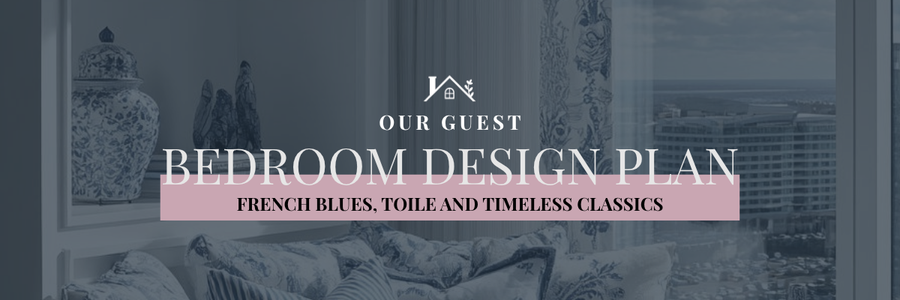
  • Our Guest Bedroom Design Plan: French Blues, Toile & Timeless Details

    Our Guest Bedroom Design Plan: French Blues, Toile & Timeless Details

    There’s something about a guest bedroom suite that feels a little more considered than the rest of the house. A space that determines friends and families stay. It should feel calm, welcoming, and quietly thoughtful — somewhere that allows people to completely switch off.

    From the beginning, I knew I wanted this suite to feel timeless and fresh. Classic and gently layered rather than overly fussy. A space that feels like it’s always been there.

    The direction for this room came together quite quickly. I kept coming back to the same feeling: soft blue tones, traditional patterns, and that slightly nostalgic, French-inspired aesthetic that never really dates.

    It’s a look that sits somewhere between:

    • relaxed country house
    • understated elegance
    • and a touch of coastal calm

    Nothing too polished. Nothing too perfect.

    Pattern plays a really important role in this room, through not only the fabrics, but also the decor.

    With the fabric, toile is the obvious hero here — it brings that classic French feel instantly, but in soft blue it feels fresh rather than overly traditional.

    Alongside this, I’ll add in:

    • ticking stripe for structure
    • soft, textured neutrals to balance things out

    The key is contrast without chaos — mixing patterns, but keeping everything within the same tonal family so it never feels busy.

    The furniture choices lean towards the traditional, but with just enough contrast to keep it looking fresh and modern.

    The metal bed frame adds a slight edge and stops the room from feeling too delicate or overly “pretty”. It anchors the space and gives a bit of definition against the softer palette.

    Painted wood pieces in soft blue tones tie everything back to the scheme, keeping the look cohesive without feeling overly matched.

    Lighting and accessories are where the room really softens.

    Wooden lamp bases, simple white shades, and subtle blue & white decorative pieces help build that layered, lived-in feel. Nothing is too styled or overly curated — it’s more about creating a space that feels comfortable and natural.

    Small details, like books, china, florals, and soft textures, help the room feel finished without trying too hard.

    For me this room was all about feeling fresh and inviting.

    It would be easy to add more — more pattern, more colour, more “moments” — but the intention is to hold back. To let each element breathe.

    Because ultimately, the goal isn’t just to create a beautiful room.

    It’s to create a space that feels calm the moment you walk into it. Somewhere that feels quietly put together, without needing to shout about it.

    With the design direction now in place, the next step is to bring everything together — and see how it translates from moodboard to real life.

    Because if there’s one thing I’ve learned already, it’s that no matter how carefully you plan…

    Something always changes along the way.


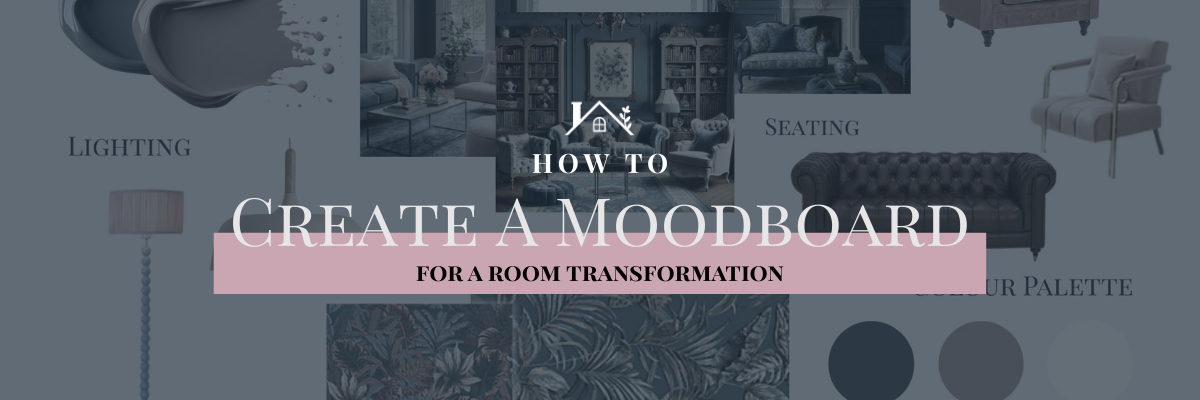
  • How to Create a Moodboard for a Home Renovation Using Pinterest and Canva

    How to Create a Moodboard for a Home Renovation Using Pinterest and Canva

    Planning a home renovation can feel overwhelming — especially when you’re renovating a character property or listed building, where every decision matters and changes can be costly. One of the simplest ways to bring clarity to your ideas before the dust, disruption and design decisions begin is to create a moodboard.

    Using Pinterest to gather inspiration and Canva to pull it all together, you can create a clear, visual direction for your renovation or room trannformation — without needing a designer or expensive software.

    I love a good moodboard, here’s how I easily get my ideas out of my head and onto paper.

    When renovating a period or listed property, it’s easy to fall into one of two traps:

    • Playing it too safe and losing character
    • Mixing too many styles and ending up with a confused space

    I find a moodboard helps ensure you strike a balance.

    It allows you to:

    • Visualise the finished space before committing
    • Keep character and history front of mind
    • Make confident decisions on paint, materials and finishes
    • Communicate your vision clearly to trades and suppliers

    Think of it as your renovation compass — something to return to whenever decisions feel hard. I quite often find I’m still updating/tweaking as the journey moves on and I learn more about the building.

    how to create a moodboard for a room transformation

    Pinterest is your starting point for exploration.

    Instead of something vague, be specific:

    • Victorian Farmhouse Living Room Moodboard
    • Listed Building Kitchen Renovation
    • Neutral Country Bedroom Ideas

    This helps Pinterest serve you better suggestions — and keeps your ideas cohesive. You can then break it down into sections within that board. I did this to keep all the bathrooms together, but then had a section for each specific bathroom. You could also use to split out flooring from lighting etc. Whatever works best for you.

    At this stage, don’t analyse too much. Pin anything that:

    • Stops you scrolling
    • Feels like the atmosphere you want
    • Includes colours, textures or layouts you’re drawn to

    Look for:

    • Whole rooms
    • Close-ups of finishes
    • Architectural details
    • Lighting styles
    • Flooring Styles

    Aim for 25–40 pins initially.

    This is where the magic happens.

    Go back through your board and remove anything that:

    • Feels trendy rather than timeless
    • Doesn’t suit the age or character of your home
    • Clashes with the overall mood

    Patterns will start to emerge — similar tones, materials, layouts or styles. That’s your direction revealing itself.

    Before you open Canva, take a moment to get clear on the big picture.

    Ask yourself:

    • Is this space warm or light?
    • Rustic or refined?
    • Traditional with modern touches?

    Most renovation moodboards come down to:

    • 2–4 core colours
    • 1–2 dominant materials
    • One clear overall feeling

    You’re not choosing exact products yet — you’re defining the vibe.

    Canva is perfect for turning inspiration into something tangible.

    Search Canva for:

    • “Interior moodboard”
    • “Collage”
    • Or use a blank A4 or square canvas

    Simple layouts work best, especially for renovation planning.

    how to create a moodboard

    Download your favourite pins and upload them to Canva.

    Tips for arranging:

    • Mix wide shots with close-up details
    • Group similar tones together
    • Leave breathing space — less is more

    Your board should feel calm and intentional, not busy.

    This is what transforms a moodboard from inspiration to a working tool.

    Use Canva’s shapes to add swatches representing:

    • Wall colours
    • Wood tones
    • Accent shades

    You can sample colours directly from images using Canva’s colour picker.

    Light, minimal text works well:

    • “Warm neutral walls”
    • “Natural timber throughout”
    • “Soft aged brass finishes”

    This is especially helpful if you’ll be sharing the moodboard with trades or suppliers. You can also play around with Canva’s elements if you want to add graphics such as arrows, or in my case, a paint ‘splodge’ to help really bring the paint colours to life.

    Step away and come back later.

    Ask yourself:

    • Does this feel cohesive?
    • Does it suit the age of the property?
    • Will I still love this in five years?

    If something feels off, tweak it. Moodboards are meant to evolve — just like renovations. Quite a few of mine are still being tweaked now, as my ideas develop.

    A renovation moodboard isn’t about having all the answers — it’s about creating confidence.

    Using Pinterest and Canva together gives you:

    • Direction without pressure
    • Inspiration without overwhelm
    • A clear vision to guide every decision

    If you’re renovating a home with history, this step is invaluable. It keeps the soul of the house intact while making it work for modern life.


    👉 If you’re mid-renovation, you’ll find more moodboards, real-life decisions and honest progress over on my renovation playlists on YouTube — don’t forget to subscribe so you don’t miss what’s next.

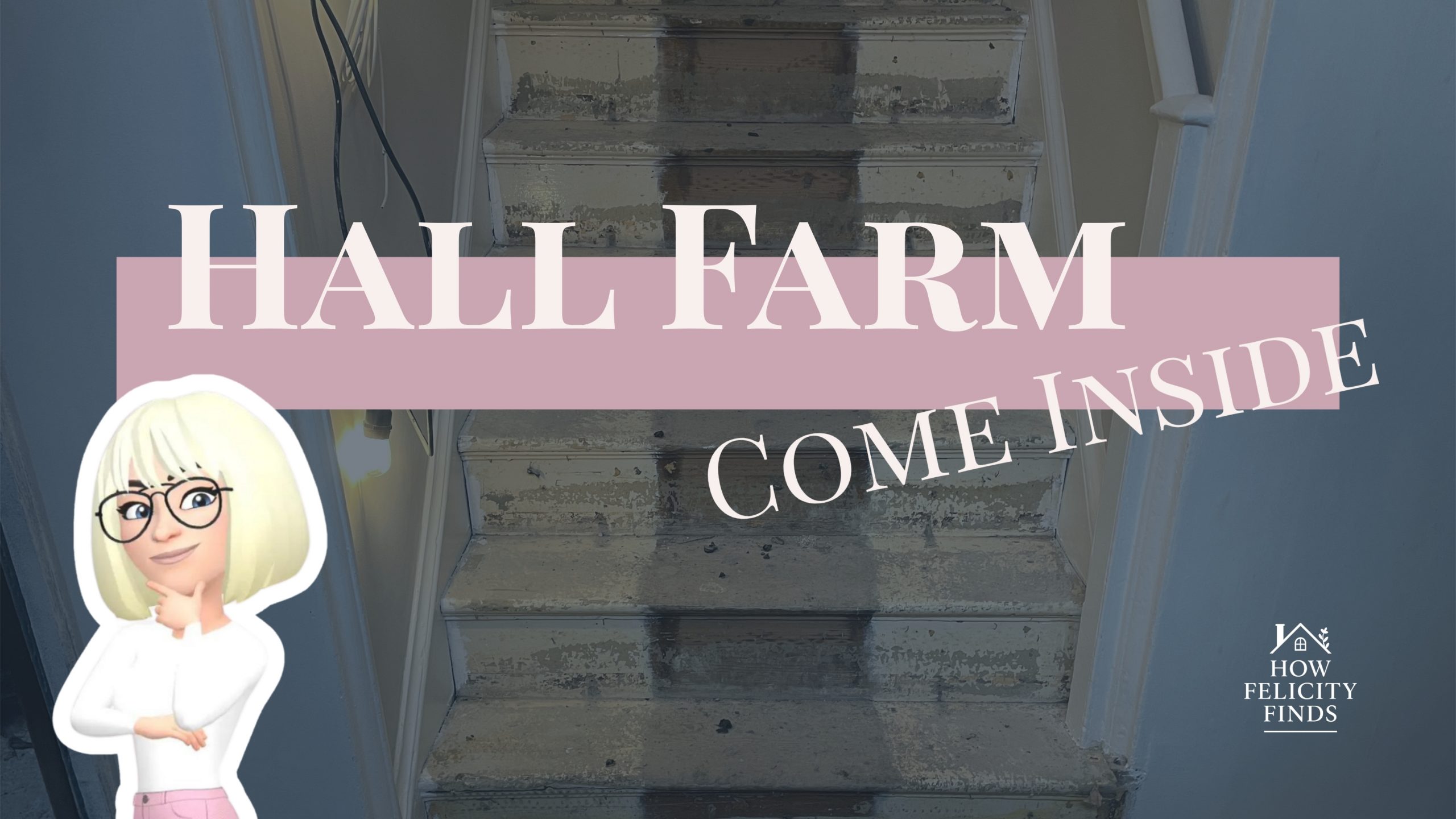
  • Hall Farm Come Inside Our Grade II Listed Farmhouse

    Hall Farm Come Inside Our Grade II Listed Farmhouse

    Before we bought our Grade II listed Victorian farmhouse, we had just 10 minutes to look around.

    No second viewing.
    No measuring.
    No time to fully process what we were taking on.


    That short window became the moment we decided whether to buy the house that’s now our biggest project yet.

    I’ve shared a walkthrough in my latest YouTube video in roughly the same amount of time, to give you an idea of just how little time we had! It’s a little raw in places (all my proper filming equipment is currently in boxes somewhere), but it captures the reality — the unknowns, the nerves, and the spark that made us say yes anyway.

    Since then, the progress over the last few weeks has been incredible — and we’re now just weeks away from finally moving in.

    If you’re interested in property, renovation, heritage buildings, or the reality of taking on a long-term project alongside full-time work and family life in video, then subscribe to the YouTube channel. It will give you a great insight as our journey progresses!

    🎥 Watch the video above

    Sometimes the biggest decisions really do happen in the smallest windows of time.


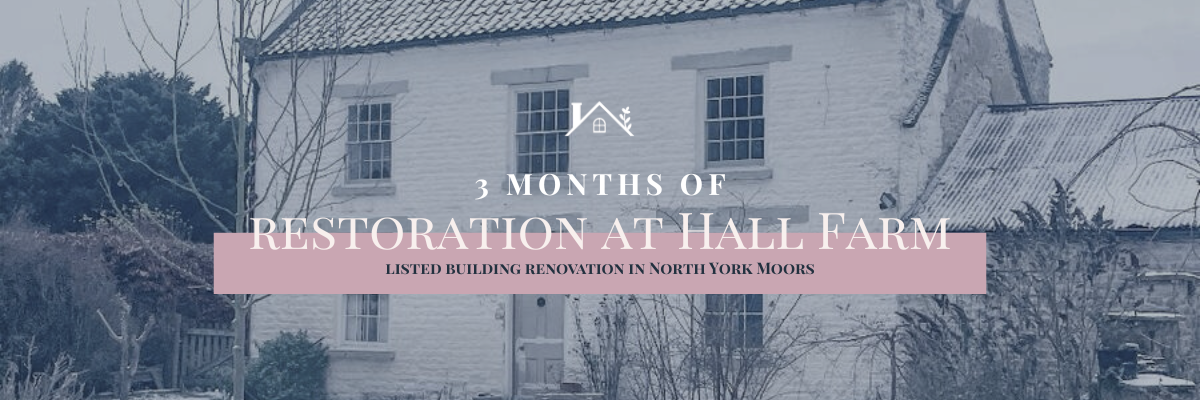
  • 3 months of Restoration at Hall Farm: Listed Building Renovation in Yorkshire

    3 months of Restoration at Hall Farm: Listed Building Renovation in Yorkshire

    As a new year begins, we’ve found ourselves looking back at just how much has changed at Hall Farm over the past three months. Owning a listed building in the heart of Thornton-Le-Dale, Yorkshire, has always felt like a privilege, and these last few months truly marked a turning point in our renovation journey. What once felt like an endless to-do list has slowly transformed into real, tangible progress.

    Much of the work completed so far hasn’t been the glamorous, Instagram-ready kind — but it has been essential. We began by completely rewiring and replumbing the house, carefully threading modern infrastructure through centuries-old walls. These upgrades were designed to future-proof Hall Farm. Ensuring it remains safe, efficient, and comfortable, while respecting its historic fabric.


    Alongside this, we installed a brand-new boiler — a small miracle for anyone who has lived through a Yorkshire winter in a draughty old farmhouse. The chimneys have been inspected, made safe and will be restored fully this year. It has made an enormous difference to daily life here.

    Some of the most satisfying moments came from restoring what was already here. We have spent weeks dipping, sanding and waxing the original doors and windows, bringing their character back to life. The last of the windows will be refitted this month. The same goes for the original beams, which were carefully sandblasted to reveal their age, texture and history — a reminder of just how many stories these timbers have held.

    The kitchen, once dark and impractical, was completely ripped out. While it’s still very much a work in progress, clearing the space felt symbolic — making room for something new while honouring what came before.

    Perhaps the most traditional craft we embraced this year was lime plastering. Messy, slow and incredibly rewarding, it has helped the house breathe again. As well as reinforced our commitment to sympathetic restoration rather than quick fixes.

    When we stand back now, Hall Farm feels healthier, stronger and more itself than it has in decades. There’s still plenty to do, but this year laid the foundations — literally and figuratively — for everything to come.

    If you’d like to follow along as we continue restoring this little piece of Yorkshire heritage, we’d love you to subscribe and join us for the next chapter.


  • 5 Achievements I’m Most Proud of in 2025 (And What They Taught Me)

    5 Achievements I’m Most Proud of in 2025 (And What They Taught Me)

    As the year draws to an end, it seems only natural to reflect on what has passed and what may follow. 2025, for various reasons, has been quite a year for us, both good and bad. But on the last day of my 51st year, I’m manifesting that 2026 is the year that brings growth, both personally, professionally and financially.

    I am not one for dwelling on the past or having regrets, as we literally cannot change the past. To me, everything we go through is a lesson that we need to learn from and grow within ourselves. And I’ve certainly learnt a lot this year. So, I thought, what better than to reflect on my personal achievements for 2025!

    This has been a particularly hard lesson to learn, and probably taken the longest so far. Raised in the years where we were brought up to be people pleasers, and with a severe case of RSD (Rejection Sensitivity Dysphoria), I was never very good at speaking up for myself. So when I became a mother, this trait seemed to follow. Now, while I know my two eldest have different needs, they were very much manageable and so therefore weren’t truly apparent until later in life. We seemed to naturally find coping strategies and skills to help them navigate life.

    My youngest, on the other hand, had much higher needs, which were apparent from the moment he started school. At the time, I worked at an independent school, and so he was able to attend Junior School there. This meant smaller class sizes, individualised lessons and support. So again, whilst his struggles were greater, they were still ‘manageable’. Until they weren’t…

    Somewhere around Year 5/6, when the pressure began to increase, the workload became a little more and expectations grew, we began to lose the happy boy we all knew. Meltdowns were commonplace, GP and CAMHS appointments became the norm, and suddenly, we were on the road to an EHCP (Educational Health Care Plan).

    The next two years were tough as we navigated a few months at mainstream, then years of school avoidance. Becoming ‘THAT’ parent ultimately gained him a place at a specialist school. I still find it difficult, I won’t deny that, but luckily, my RSD has actually helped. Determined not to be ‘found out’, I read up on all things neurodivergent. Taking it even further and gaining my Level 3 SEND Law qualification with the IPSEA charity. I might still be uncomfortable speaking up for my son, but I’m confident in my knowledge, and I won’t stop fighting!

    Lesson Learnt: When needed, you are stronger than you realise!

    Another side of being a people pleaser is always doing everything for everyone else. It’s often just to keep others comfortable. Again, because the eldest two needs being less, we’ve been lucky and didn’t have to make too many sacrifices. However, I now see the two eldest only at holidays, really, so I cherish the time I have with them. And Sam’s needs have always been greater, so recently we really have had to sacrifice and cut back on things we would have previously taken for granted.

    Holidays tend to be quite difficult, as all our boys are very different, and finding something they all like is tough. My prerequisite is always going to be, if my kids are happy, then I’m happy. So now, more often, we look at separate holidays, shorter breaks and balancing it out over the year.

    When it comes to social events, I no longer insist on my kids being there. If they don’t want to go to something, then I won’t make them, and will give my apologies. If my youngest wants to go, but then finds it too overwhelming, then I’ll make our excuses and leave. Obviously, there are certain family obligations that are non-negotiable for the eldest two – funerals, weddings, etc. – but even then their jobs/studies mean they can’t walys make anyway. But for Sam, we deal with everything as non-committal and see how he is in himself on the day.

    Lesson Learnt: Acknowledge your kids’ struggles, ensure they aren’t masking (as we spent our lives doing).

    I have spent too many years feeling like the worst daughter, the worst student, the worst friend, the worst employee and the worst mum. It has truly taken till this year and understanding my brain so much more, to be able to forgive myself.

    Life is too short to worry about what other people think, and there will always be people who will judge you (no matter what), so why judge yourself on top of that? One of my favourite tattoos is the song lyric from Tupac’s song of the same name: “Only god can judge me.”

    Now in 2025, my circle is small, I no longer crave outside approval, I am comfortable in my skin and have no desire to be liked by everyone. My brain is how it is; I cannot change that. Now, I work with it and ensure that I know my limits. I’m not perfect, and no one is, but I know that I’m the best version of myself.

    Lesson Learnt: Never stop learning, but understand your limits, they are not faults or flaws!

    When I first realised Sam might have demand-avoidant traits, I knew already that it presented differently. I just wasn’t prepared for how hard it would actually be to be in that moment. Every natural reaction is push harder, become stricter, impose more rules, but actually it doesn’t work. All that happens is your child is more dysregulated, and usually, you end up the same, too!

    I can’t tell you the number of years I spent sobbing on the stairs as I tried to coax him into school. The number of times I pushed harder, only to be met with screams and physical violence. How I’d have to watch my child get to such a state of despair that he would threaten suicide.

    It’s interesting, as soon as you begin to look at demand avoidance, you realise just how many everyday tasks we all take for granted are seen as demands: getting up, getting dressed, going to school, chores, pretty much everything you can think of. My biggest lesson was learning not to gentle parent as such, but how to re-frame how I spoke to Sam and how we worked together to deal with the tough times. Even when it seemed easy to others…

    Lesson Learnt: Watch your child’s behaviours, they are communicating their struggles, not obstinacy.

    I have spent years not fully understanding why I would/could only commit to one ‘thing’ a day. That weekends were a recovery from the week, rather than a restful break and catch-up. Unknown to me, I was protecting myself from overwhelm without realising.

    But gradually, being a people pleaser meant I found myself taking on more and more, at work and personally. Not able to see the overwhelm creep up till it was too late, and then I’d spend days on the sofa, barely able to speak.

    This year, with all of the above and growing work pressures, I’ve ended up pushing myself to the point of burnout. Having to be signed off work and re-look at my lifestyle and make major changes. I’ve always found it hard to say no to people and set boundaries, but this year I’ve had to; it literally was the difference between surviving and not.

    Lesson Learnt: It is not rude to turn down an invite or take a step back from obligations.

    This year, I chose to focus on personal achievements, rather than what I may have previously viewed as failings. 2026, like 2025, will be the same. Focus on the positive and learn from the negative.

    How has your 2025 been, and how do you intend to move into 2026?