Did you know there are around 34 recognised symptoms of perimenopause and menopause? And as research continues, that list seems to keep growing. We all know about hot flushes and night sweats, but here are five surprising menopause symptoms that might just shock you…
Electric Shocks
Many women describe experiencing strange sensations like electric shocks, jolts or tingling during menopause. While they can be alarming, they’re generally harmless, but understanding why they happen can make them feel a little less scary.
The exact cause isn’t fully understood, but fluctuating hormones are thought to play a role. Oestrogen helps regulate nerve function, so as levels decline, nerve signals may become a little more erratic, leading to these odd sensations. Stress and anxiety, which often increase during perimenopause, can also make them feel more noticeable.
I remember working in an office where all but one of the women were over 40, and we were constantly giving each other electric shocks. Doors, filing cabinets, handshakes… it became such a running joke that we stopped questioning why it was happening!
Burning Mouth
Many women experience the fiery discomfort of Burning Mouth Syndrome (BMS) alongside the many other changes menopause brings. It can feel as though you’ve scalded your tongue on a cup of tea, even though you haven’t.
Research suggests it affects a significant number of menopausal women, making it far more common than most of us realise. While the exact cause isn’t fully understood, hormonal changes are thought to affect the nerves responsible for sensation in the mouth.
If you’ve been experiencing burning, tingling or soreness in your mouth without an obvious cause, it’s worth speaking to your GP or dentist to rule out other conditions and discuss possible treatment options.
Increased Food allergies / intolerances
One thing I never expected as I headed into perimenopause was how much my body suddenly started reacting to foods I’d eaten for years without a second thought. While hot flushes and sleepless nights get a lot of the attention, increased food sensitivities and intolerances are a much lesser-known symptom that so many women seem to experience.
As our hormones fluctuate, particularly oestrogen, it can affect our gut health and even the way our immune system responds. Foods that never used to cause a problem can suddenly leave you bloated, itchy, congested or feeling generally unwell. It doesn’t necessarily mean you’ve developed a true food allergy, but if you’ve found yourself wondering why your body seems to have changed overnight, you’re definitely not imagining it.
Cold Flushes
Everyone has heard of hot flushes, but their much less famous cousin is the cold flush.
These sudden waves of chills can leave you reaching for a jumper one minute, only to be peeling it off again five minutes later. Like hot flushes, they’re thought to be caused by fluctuating hormones affecting the body’s temperature regulation. Instead of triggering sweating, your blood vessels constrict, leaving you shivering, covered in goosebumps and wondering what on earth is happening.
It’s estimated that around one in five women experience cold flushes during menopause, yet they are rarely talked about.
Rage
Menopause rage is something nobody really prepares you for. We hear plenty about anxiety and brain fog, but nobody talks about the overwhelming, white-hot anger that can seem to come out of nowhere. One minute you’re absolutely fine, and the next you’re full of rage because someone breathed too loudly, left a cupboard door open or asked you the same question twice.
It’s not about being an angry person. It’s about fluctuating hormones affecting your mood, stress levels and emotional regulation.
For me, it’s one of the most unexpected and misunderstood symptoms of perimenopause, and it often comes with a huge feeling of guilt afterwards. I get angry at the kids, I get angry at my husband, I get angry at inanimate objects, and I especially get angry at myself. All the while, the sting of ADHD overthinking and rejection sensitivity hovers in the background, making it ten times worse.
My symptoms
Electric shocks were actually one of my very first symptoms, and I certainly didn’t put them down to menopause. Most days, I managed to zap myself on light switches, door handles and computers before passing the electric shocks on to my kids, my friends and anyone else brave enough to shake my hand. I actually stopped shaking hands for quite a while! Thankfully, they do seem to have settled down now.
The food intolerances, however, have completely changed the way I eat. Foods and drinks I used to enjoy are now firmly off the menu, and it’s the one symptom that has continued to get worse as my perimenopause has progressed. The thought that it could be here to stay is, if I’m honest, a little depressing.
It’s another reminder that menopause affects so much more than our periods. The more we talk about these unexpected symptoms, the more women realise they’re not alone, and that what they’re experiencing is real.
Have you experienced any of these symptoms? I’d love to hear your experiences in the comments.
Parenting a Child with PDA: The Toll Nobody Talks About
What PDA Actually Looks Like Day to Day
PDA, is known officially as pathological demand avoidance, but has more recently been reframed as a persistent demand for autonomy. A much better way of explaining what PDA is and what a PDAer’s struggles are. Originally seen as a specific profile linked to Autism, PDA is now known to have a strong connection to conditions such as ADHD, ODD, language disorders and trauma-related presentations.
Those with a PDA profile will often be judged as obtuse, defiant, and badly behaved. However, they require both control and autonomy in their lives. Demands (however small) remove that autonomy and control; therefore, they can become dysregulated and overwhelmed.
Take a school morning, think of all the demands that come with simply getting up and out to school:
Wake Up
Get Dressed
Eat Breakfast
Brush Your Teeth
Pack Your Bag
These demands have to be reframed to give the child back control. Obviously, in a parent-led way, not simply letting them rule the roost.
Why PDA Parenting Hits Different — And Why It’s So Exhausting
Being a PDA parent is like being a permanent negotiator. Every morning becomes an intricate dance of ensuring your child follows the steps they need to go to school or a club/activity. While also ensuring those steps give the child a sense of control and decision-making. Before you even speak, you have to think about what you are about to say, how it may be perceived and what outcome is required.
You learn very quickly how to take a demand and turn it into a choice. You also learn that you can try your very best and still manage to say the wrong thing. Suddenly you are negotiating World War III. It’s hugely tiring to have to think about everything you say and do. You end up walking on eggshells, afraid to say anything that might be perceived as a demand.
The Emotional Toll of Parenting a PDA Child
A 2025 study found that families with PDA children often spent a lot of time at home to help their child stay regulated. The unpredictability of dysregulation and the reliance on parents for support were described as isolating. Parents reported having limited time to attend to relationships with other family members due to the competing demands of raising a PDA child.1
I am so lucky to have understanding friends and family. However, I am very conscious of how inflexible I have to be when it comes to nurturing those relationships. As a parent of a PDA child, I often feel judged, blamed, and isolated. I still find that many professionals frequently fail to understand, and traditional compliance-based strategies make things considerably worse. Being a woman of a certain age, I was brought up to worry about what others thought. It has taken a long time to unlearn that. To allow myself to parent the way I know is right for my child, no matter what others think. It can be hard, though; there is still a lot of judgment.
When Your Own Nervous System Takes the Hit
As mentioned earlier, I often feel like I’m walking on eggshells, especially if a specific outcome is required. I will play conversations in my head ahead of time to ensure I have considered all the demands in that conversation. And how I can phrase them differently to achieve a smooth outcome. I am always on high alert; even the simplest conversation can turn on the flip of a coin if a demand is given. It is emotionally demanding and leaves me feeling exhausted and on edge.
When we then look at the fact that neurodivergence has a familial connection, then quite often parents can also have traits or a diagnosis. Which means we have our own struggles on top of simply parenting a PDA child. Many women (myself included) report realising they were indeed ADHD or autistic after their child is diagnosed. Looking back at family history and childhood episodes can often give you that ‘lightbulb’ moment. But this does mean that, quite often, the behaviours triggered by a lack of perceived autonomy can then trigger your nervous system, creating a vicious cycle that is hard to break.
A 2023 survey of more than 700 parents found that 57% self-reported burnout. That’s in the general population, before you layer in the specific and relentless demands of PDA parenting.2
PDA Parenting Burnout — and How It Sneaks Up on You
A decline in our mental and physical well-being, as well as a strained relationship with our child, is the beginning of parental burnout. As mothers, especially, we tend to put our needs last and minimise the impact things have on us. This can lead to burnout sneaking up on us, and we may not realise it until too late. Other signs of parental burnout include a reduced emotional connection, increased conflict in the home, and negatively impacted relationships with others. Initially, we can blame ourselves for this. Rather than recognising it is down to a reduced capacity both emotionally and physically.
Low-Demand Parenting: What It Is and Why It’s Not “Giving In”
A lot of people assume that low-demand parenting is similar to gentle parenting, and whilst there are similarities, they are two entirely different techniques. The core difference is this: gentle parenting still involves requests, expectations, and boundaries — just delivered warmly. Low demand parenting questions whether the demand should exist at all. It starts from the position that for a PDA nervous system, any perceived demand — however kindly worded — triggers an anxiety response that overrides everything else. So the work isn’t in how you deliver the demand; it’s in whether you issue it in the first place.
Low-demand parenting wasn’t developed as a parenting philosophy for the general population. It grew specifically out of the PDA community, primarily through the work of people like Dr Casey Ehrlich (At Peace Parents), who recognised that standard approaches, including gentle parenting, simply don’t work for demand-avoidant children and can actively make things worse. Believe me when I tell you that we are not ‘giving in’; low-demand parenting is so tough. You essentially have to relearn how to parent; this is not a choice; it is a necessity!
Strategies That Actually Help — For Both of You
The most useful thing I learnt and would advise immediately to all parents of a PDA child is not to sweat the small stuff. When everything becomes a negotiation, and the smallest task is akin to the Brexit deal (no one really wins, and there’s still a dispute over the terms!), then you quickly realise which battles need to be fought and which don’t.
Negotiable: what socks to wear, eating at the table, cutting the crust of sandwiches.
Non-negotiable: not many – anything that is the difference between being safe and not, or being alive or not.
Look at the outcome and decide which ‘demands’ must be met to get there. Where possible, give your child a choice about the order of these steps, or remove a step entirely if it won’t make a difference to the outcome. Try, where possible, to turn the ‘demand’ into a choice. Obviously, a child has to wear shoes to go to school; that is your outcome, but instead of ‘put your shoes on’, it can be re-framed as ‘which shoes would you like to wear, the black trainers or the grey trainers?’. This gives them the control and autonomy they need, whilst giving you the outcome you require.
Reduce verbal demands as much as possible. For younger children, this can be done using visual charts to guide each step. Turning steps into a game also works well with younger children (we used to regularly play the ‘who can get dressed first’ game on school mornings)
You’re Not Failing — You’re Parenting a Different Operating System
Even after years of parenting my PDA child, I still have those days when nothing seems to go right, and I feel like a failure. Parenting is hard enough, but when you add in that you have to think so hard about every single thing you say to your child. Then add in having to watch them struggle as they try to negotiate a world that their brain isn’t wired for. It’s tough. But that’s the part to remember: their brain is wired differently; they are not being obstinate or choosing to behave as they do. Just as we are not equipped naturally with how to parent a PDA child. When you have your first baby, did you know what you were doing? PDA parenting is simply learning what works for your child.
Research itself acknowledges the gap – future studies have been called for to evaluate mental health outcomes. Alongside associated interventions specifically for parents of PDA children. Systematic evaluation of parenting stress is recognised as warranted in this group. Research is only just catching up to what we have known for years.
It is one of the hardest journeys I’ve been on and can be very lonely and demoralising at times. Be kind to yourself and know that you are not alone. We are all in this together.
Fay x
These are two books that I found particularly helpful when we began our PDA journey.
Does your ADHD or autistic child struggle with a morning routine? It’s not laziness, defiance, or bad parenting. Every morning feels like Groundhog Day. You’ve woken them countless times. You’ve called them even more. Shoes are nowhere to be found, and the socks don’t feel right. All this, all before 8 am. If this rings a bell, you’re not alone.
There are neurological reasons why mornings can be genuinely difficult.
Why Does My ADHD Child Take So Long to Get Ready for School?
ADHD – Struggles with executive function and sleep make it hard for anyone with ADHD on a morning. Lots of ‘tasks’, plus possibly still not being fully awake, is not a great mix.
Autism – For children with autism, transitions can be difficult. Mornings, in particular, involve many transitions within a relatively short time. Plus, there’s the added worry of having to ‘mask’ all day at school.
PDA – For a child with a PDA profile, the above tasks and transitions can all seem like a long list of demands. Add in the anxiety/anticipation of the school day, and it can be overwhelming before they’ve even got out of bed.
Anxiety – The anticipation of trying to fit in, reading social cues, and understanding what is expected of you at any given time can be hugely anxiety-provoking in many neurodivergent children.
Executive dysfunction – For many neurodivergent children, executive dysfunction means that seemingly simple tasks like getting dressed, packing a school bag or leaving the house can feel overwhelming because their brain struggles to organise and initiate the steps involved.
Transitions – We tend to think of the bigger transitions, like moving from junior to senior school, or moving up a year group each year. But for children with ADHD and autism, transitions can be about the everyday, like waking up each morning.
ADHD and Morning Struggles: It’s More Than Just Being Tired
Executive Dysfunction Makes Starting Tasks Hard
There are a huge number of tasks to complete every morning before school:
Wake Up
Get Dressed
Breakfast
Brush Teeth
Pack School bag/PE Kit
Remember Homework
Make the School Bus
And that’s just the basics. Research suggests that children with ADHD may experience a delay in executive functioning development of around 30%, meaning a 10-year-old with ADHD may have organisational, planning and self-management skills more similar to those of a 7-year-old.
Sleep Inertia and Delayed Sleep Patterns
If your child with ADHD seems to come alive at bedtime but is impossible to get moving in the morning, there may be a biological reason. ADHD is strongly associated with delayed sleep patterns, meaning their internal body clock runs later than expected, making early school mornings particularly challenging.
Some experience sleep inertia, meaning they feel groggy and disoriented long after waking. Sleep inertia in the general population often lasts around 15–30 minutes, but can extend to an hour or more in some individuals. ADHD appears to be associated with more severe and prolonged sleep inertia.1 It can be advisable to build in a longer ‘buffer’ in the morning, anything from 45 mins to 90 mins.
Children with ADHD are two to three times more likely to experience sleep problems than their neurotypical peers.2
How Autism Can Make School Mornings More Difficult
Transitions Are Hard Work
As mentioned earlier, we tend to think of ‘larger’ transitions, but for many autistic children, every day is full of lots and lots of smaller transitions that neurotypicals take for granted.
moving from being asleep to awake
having to get dressed
transitioning from home to school
moving from classroom to classroom, each lesson
transitioning from lesson to playtime to lunch and back again.
Each of these transitions requires a huge amount of energy for an autistic child to make.
The Hidden Stress of the School Day
Which brings me perfectly on to the point of hidden stress. The effort that a neurodivergent child will have to use to simply get through the day is enough to make them anxious or even overwhelmed. Not knowing exactly what to expect, having to manage friendships, teachers’ expectations and school work, can all be huge stress points throughout the day, and the anxiety can begin as soon as they wake.
Understanding PDA and Morning Resistance
Why Everyday Tasks Can Feel Like Demands
For a neurodivergent child with PDA (commonly known as Pathological Demand Avoidance), another level of anxiety is added. All the tasks that are already hard to manage suddenly feel like demands. For a child with PDA, feeling ‘in control’ is hugely important. A better way to look at PDA is as a pervasive desire for autonomy. So tasks and questions can be perceived as demands and will be met with resistance.
It’s Not Refusal — It’s Often Anxiety
The anticipation of the unknown can be so anxiety-inducing that a PDA child will simply refuse to even try. It can seem like defiance or stubbornness, but it is a neurological difference in the way their brains perceive the world around them and their expectations. Even praise can be seen as a demand, because they perceive it as meaning they must work to this level each time.
What School Mornings Might Feel Like for Your Child
Before they’ve even left their bed, they may already be thinking about getting dressed, navigating friendships, coping with noise, following instructions, and masking all day. My youngest really struggles to trust what he is being told and the people around him. He needs routine and predictability after years of change and feeling let down by previous education settings. So each morning is like a new morning with the same anxieties, worries, demands, until he can build that trust again.
Practical Ways to Make Your ADHD Child’s Morning Routine Easier
Reduce Morning Decisions
Write a list of all the decisions that need to be made on a morning. There will be more than you originally anticipated. Are there any you can remove from the list completely, or move to a different time, like the night before?
Prepare as Much as Possible the Night Before
If tasks can be moved to the night before, then it’s really advisable to do so. Things like laying out uniform/clothes the night before. Making sure the PE Kit is ready and packed if needed. If there is homework, is it completed and packed in the school bag?
Break Tasks Into Tiny Steps
For larger tasks, break them down. Telling your ADHD or autistic child to simply get ready for school can be overwhelming. Break it down into manageable steps, giving one at a time as they complete each step.
Offer Genuine Choices
For children with a PDA profile, how you word things can have a real effect. Rather than saying ‘brush your teeth, get dressed’, give them the choice of which they’d like to do first. Or you can simply state that their toothbrush and toothpaste are at the basin when they are ready to brush their teeth.
For younger children, try making tasks a game. We would quite often ‘see who can get dressed’ first, or ‘who could brush their teeth best.’
Use Visual Prompts Instead of Constant Verbal Reminders
Spoken voice can be construed as a demand or overwhelming, especially if your child has sensory struggles. Using visual reminders can be very useful under these circumstances. A morning routine ‘to do’ chart, where children can tick off each task as completed, can work well with some (keep it simple). What I found worked well with Sam were visual hand cues. So, rather than going in every 10 mins to tell him the time, a demand in itself. Then, simply replacing my voice with holding my hand up to show how many minutes were left (so five fingers for five minutes), worked well.
Focus on Connection Before Correction
Where possible, try not to correct your child in the morning. When they are already anxious or possibly internalising overwhelm, then correcting them can be the straw that broke the camel’s back. Try instead to connect with them, explain that you can feel their struggles and ask what would help. Or simply move past the ‘error’ and try again in 5 minutes, even helping them to achieve.
When Morning Struggles Might Be a Sign of School Anxiety
While ADHD, autism and PDA can all contribute to difficult mornings. It is worth considering whether school anxiety may also be playing a role. If your child seems particularly resistant on school days but is happy to get up on weekends, or for activities they enjoy. Then their morning struggles could be a sign that they’re feeling overwhelmed by something at school.
What Helped Me Reframe Our Morning Battles
As soon as I realised that my children were not deliberately being difficult but were struggling, my thinking shifted. Being a SEN parent who is neurodivergent myself, the struggles were not so obvious for my two eldest. Without realising it, I had built many of the above steps into our routine because they helped me in the morning. Which in turn helped them.
However, the struggles with my youngest were so much greater. When EBSA (emotionally based school avoidance) set in after a disastrous transition to a mainstream secondary school, I had to question the very way I parented. That’s another story for another day. Suddenly, what had worked previously no longer did. Realising that his ‘behaviour’ was actually him trying to communicate with me really helped.
Final Thoughts: Your Child Isn’t Giving You a Hard Time
Children with ADHD, autism, and PDA aren’t usually choosing to make mornings difficult. More often, they’re having a difficult time navigating a world that asks a lot of them before the day has even begun.
Once we start to approach their behaviour as struggles and listen to what they are trying to tell us, it makes things a lot easier. Parenting neurodivergent children is not easy. But you are not alone, and small changes can make a big difference. I’m always available on socials or by commenting below. What small change did you find helped, or are you still in the battleround?
Fay x
Frequently Asked Questions
If your ADHD child struggles to get out of bed for school, it isn’t usually because they’re being lazy or difficult. Many children with ADHD experience executive dysfunction, which can make starting tasks incredibly challenging, even when they know they need to do them. Some children also have delayed sleep patterns or experience sleep inertia, meaning they feel groggy and disoriented long after waking.
For children who are also autistic or have a PDA profile, the thought of the school day ahead can feel overwhelming before they’ve even left their bed. The combination of transitions, expectations, sensory demands and social pressures can make getting started feel like the hardest part of the day.
Yes, many children with ADHD find mornings particularly challenging. ADHD can affect sleep, motivation, task initiation and time awareness, all of which are important when getting ready for school. While some children appear fully awake, they may still struggle to organise themselves, prioritise tasks or move from one activity to the next.
Mornings often involve multiple demands in a short space of time, from getting dressed and eating breakfast to remembering homework and leaving the house on time. For an ADHD brain, this can quickly become overwhelming, leading to delays, frustration and stress for the whole family.
Yes, morning resistance is very common in children with a PDA (Pathological Demand Avoidance or Persistent Drive for Autonomy) profile. Everyday tasks such as getting dressed, brushing teeth or leaving for school can be experienced as demands, triggering anxiety and a strong need to maintain control.
This doesn’t mean a child is choosing to be oppositional. In many cases, their nervous system is responding to feelings of pressure or overwhelm. Reducing demands, offering genuine choices and approaching mornings with flexibility and collaboration can often be more effective than repeated reminders or consequences.
There isn’t a one-size-fits-all solution, but many parents find that reducing the number of decisions and demands in the morning can help. Preparing school bags, uniforms and lunches the night before can reduce stress and make mornings feel more manageable.
Breaking tasks into smaller steps, using visual reminders and offering choices can also support children with ADHD, autism or PDA. Most importantly, try to focus on connection rather than conflict. Understanding why your child is struggling can help you find strategies that work for your family rather than getting stuck in daily battles.
Sometimes, yes. If your child seems particularly resistant to getting ready on school days but is more relaxed at weekends or during holidays, anxiety may be playing a role. School can be demanding for neurodivergent children, especially if they are dealing with sensory challenges, social pressures, academic expectations or the exhaustion that comes from masking throughout the day.
Morning meltdowns can sometimes be a sign that a child is struggling with what lies ahead rather than the morning routine itself. Approaching the situation with curiosity rather than assumptions can help uncover whether anxiety is contributing to the difficulties and what support might be needed.
This post contains affiliate links for some products; they will be clearly marked. If you purchase through my links, I may earn a small commission at no extra cost to you. I also have a personal discount code for the collagen I mentioned — I can’t share it publicly, but drop a comment below or message me on Instagram, and I’ll send it over. I only ever recommend products I actually use.
Since hitting perimenopause, my coping mechanisms failed, and the mask fell off. My journey with AuDHD began, and boy, it’s been a hell of a ride. And whilst dealing with all that, we decided that starting a renovation project would be a fantastic idea! So what are the products that have helped me through these last few years, and what new ones am I using in the house to help with the reno and work with my neurodivergence?
Products for AuDHD Women in the UK
THE ND TOOLKIT
From essential oils from Rebel Rituals to sleep sprays from This Works, these products help me calm my mind, focus my thoughts, and get a great night’s sleep. And when it all gets a little too much, the weighted blanket comes out to give me a huge, deep hug.
Supplements voted the Best Menopause Supplement of the Year 2025 by BBC Good Food help me get a full night’s sleep and the energy to function throughout the day. Vitamins and collagen, specifically designed by Elavate, are my secret weapons to fantastic hair and nails. Whilst my Caudalie Vinopure Serum has eradicated the hormonal acne that was one of my earliest and worst menopause symptoms.
I’ve found some great kitchen products that not only look great but also help with an ADHD brain by reducing stress, visually and literally, and ensuring we don’t run out. When you have ND kids, it’s worth more than your life to run out of their favourites!
As well as that, I know a lot of people have asked about the products and companies we are working with for the renovation, so I’ll be adding them here, too.
Coming this week, I’ll also be adding in a lot of the products and clothing we use and wear now that we live a little more rurally. Think wellies, gilets, leggings, as well as gardening tools and more as time goes on.
I’ll also list a lot of the items that have helped us as a neurodivergent family, such as labelling, vitamins and supplements, books on ND parenting, etc.
All the products listed, which we use and love, have genuinely helped us along the way. So, I really hope that they will help you too! If there is anything you want to ask, please just comment below!
I chased my ADHD assessment referral today. Turns out they’re even further behind than before. I might have another year to wait. That’s five years. Five years of knowing, and waiting, and having to get on with it anyway.
My Story
As with many older women who realise they are neurodivergent, it’s when menopause hits, and everything falls apart, that it becomes obvious. For me, my journey began with my children’s diagnoses, and as menopause took hold, things really began to fall apart. The referral was fairly straightforward, as my GP was obviously aware of the boys’ journeys, so completely supported my self-referral.
When I received the forms to complete, I thought that looking back on childhood would be quite hard. But suddenly things began to fall into place and make sense. My referral was triaged and accepted, and the wait began. In the four years since, I’ve navigated my three boys’ diagnoses, supported my youngest through almost 3 years of EBSA (emotionally based school avoidance) and an EHCP transfer, become L3 SEND Law Qualified with IPSEA Charity, managed -kinda- perimenopause, moved house and started a renovation.
The Gender Diagnosis Gap
We know that historically, ADHD was seen as the ‘naughty white boy disorder’ and something that they grow out of as they reach adulthood. There are three ‘types’ of ADHD: Hyperactive, Inattentive, and Combined. Generally, boys are likely to display the hyperactive/impulsive symptoms of ADHD, whereas girls and women tend to display more inattentive behaviour. This is one of the reasons historically the gender diagnosis gap originated. Clinical studies show that the gender diagnosis gap is 4:1 male to female. However, wider studies within the community show that this ratio may be nearer to 2:1. 1
Reasons for the gender gap are generally thought to be:
Historical bias – research was carried out on males, so the diagnostic criteria are still very much focused on male-dominated symptoms, focusing on hyperative type.
Presentation type – typically, the ‘male’ behaviours are much more external and visible, whilst ‘female’ behaviours are typically internal and much less visible, so tend to go unnoticed by parents & professionals.
GP Training – because of the above GPs are vastly undertrained in the presentation of females with ADHD, and therefore it can be harder for females to be considered for assessment.
Societal Expectations – Again, because the male behaviours are visible and go against expected behaviours in public, it is accepted more readily that this may be due to ADHD, and diagnosis sought. Whereas, within females, a lot of the time, it is initially put down to a personality trait.
Diagnosis Procedure – Girls are much less likely to be noticed and referred for assessments throughout their lives. Still, studies show that even when they are referred and assessed, women are more likely to be misdiagnosed or not diagnosed at all.
NHS vs Private (and Right To Choose)
As of early 2026, typical waiting times for adult ADHD assessment through the NHS range from 12 months to over 5 years depending on your area. Some regions have waiting lists so long that services have temporarily closed to new referrals.2
Right to Choose wait times range from as little as 1 week to up to 78 weeks, so they are significantly shorter than NHS wait times. However, many GPs are unaware of the RTC avenues, making referral difficult. And as more patients ask for RTC, providers are struggling under the pressure and are also closing their waiting lists to new referrals.3
Private ADHD assessment in the UK can be scheduled in as little as 3 weeks, but does come with a cost of between £500 and £1200.4 GPs can also refuse to accept private diagnoses and therefore the prescription of any advised medication. 5
What the Wait Costs
The cost of waiting years for a diagnosis is not only financial, though the financial reality is stark enough on its own. It is the cost of navigating life without the framework that would explain so much of it.
It is the cost of sitting with three neurodivergent boys — each at different points in their own diagnostic journeys, each needing me to advocate fiercely and knowledgeably for them — while simultaneously trying to understand a brain that nobody has yet formally confirmed as my own. The irony of holding a Level 3 SEND Law qualification, of knowing how to fight a system on behalf of my children, while being failed by that same system myself is not lost on me.
It is the cost of perimenopause landing on top of undiagnosed AuDHD with no clinical acknowledgement of how the two interact. The hormonal crash that completely disrupts dopamine regulation. The brain fog that sits on top of existing executive dysfunction. The emotional dysregulation that increases as oestrogen drops. And the total absence of any professional joining those dots in a way that might actually help.
It is the cost of the Maternal Mental Health crisis I wrote about earlier this year — the PND that went unrecognised as the neurodivergent crisis it also was, because nobody was looking for it.
And it is the quieter, more cumulative cost — the one that is hardest to quantify. The years of wondering why everything feels harder for me, than it looks for everyone else. The self-doubt that fills the space where a diagnosis should be. The energy spent masking, compensating, and holding it all together in ways that are invisible to everyone except the person doing it.
That is what the wait costs. Not just time. Everything that happens inside it.
What Needs to Change
None of what needs to change is complicated. None of it is beyond the capacity of a healthcare system that, when it chooses to, moves quickly and decisively.
Earlier screening for girls in education. The signs of ADHD in girls are present in classrooms every day — in the daydreamer who is written off as quiet, in the people-pleaser who is exhausted by the effort of appearing fine, in the girl who is bright but inconsistent in ways that confuse teachers. Catching ADHD earlier in girls means fewer women arriving at adulthood — and motherhood — without the tools to understand themselves.
Better training for GPs in how ADHD presents in women. A woman who presents to her GP with anxiety, exhaustion, difficulty concentrating, and emotional dysregulation should not leave with only an antidepressant, as I did for decades. She should leave with a conversation about whether something else might also be worth exploring. That conversation costs nothing. The absence of it costs everything.
Reduced NHS waiting times. Four years — potentially five by the time I am seen — is not a waiting list. It is a barrier. For women in crisis, for mothers in the postnatal period, for women in perimenopause when the hormonal shifts make everything harder, a four-year wait is not a delay. It is a denial.
The women waiting for these changes are not waiting quietly. They are working, parenting, advocating, and getting on with it — as women always have. But getting on with it is not the same as being supported. A system that relies on women’s ability to cope is not a system that is working. It is a system that is failing, and calling the failure resilience.
The Wait Continues. So do I…
We deserve better. We have always deserved better. And after four years, I am running out of polite ways to say so.
So, I’m still waiting. I’m still here. I’ll continue renovating the farmhouse, raising the boys, and advocating for women’s health rights. The diagnosis will come. And when it does, it will confirm what I already know.
This post discusses postnatal depression, undiagnosed ADHD, and suicidal crisis. If you are struggling right now, please reach out to PANDAS on 0808 1961 776 or Samaritans on 116 123 before reading on. You are not alone.
Maternal Mental Health Week: the ADHD and PND connection that almost cost me my life.
As I sit in the new house, surrounded by chaos yet warmed by a hot cup of tea, I can reflect on how far I’ve come. Almost two decades ago, I was in a very different place. But this isn’t meant to be a sad story, far from it. This is a story of a mother with undiagnosed adhd and postnatal depression, who fought hard, coming out not only stronger, but gentler on herself too.
With two boys under two, I found motherhood hard. I wasn’t a confident mum, but at least by the time I had my second, I had a bit of a routine going. Looking back, I can totally see the signs of the AuDHD. I clung to Gina Ford and the routine, but I also found it hard to organise myself and the boys. I couldn’t do more than 1 ‘thing’ in a day, and looked in awe and horror at friends who could visit friends and family, and fit in an activity all in the same day. But as the months went on, any feelings I had started to become numb, and any joy that had been there had gone.
Not an easy journey
I was lonely; I had moved away from family and friends, and didn’t drive at the time. And with two under two, it wasn’t the easiest to get on a bus and go out. I withdrew and spent more and more time at home. My husband had a busy social life playing golf and squash, so he would be out a lot of evenings and weekends. I knew it would be tiring, but it was beyond that; I was exhausted, constantly. I quite often felt as if I wasn’t really there, or felt nothing at all. Feeling so alone, so out of my depth, and so miserable, utterly, utterly miserable, at what should be one of the happiest moments of your life.
Over the coming months, nothing seemed to get easier; I was still struggling, still found the day-to-day difficult. Still felt nothing. I began clawing at my skin to try and feel something. My forehead was often raw and bleeding, covered by a long fringe. I began to question everything, especially my ability to be a good mother and wife. I had very little contact with friends and family and hid away from the world. The final straw was not being able to attend a family event because the OH was playing golf. That night was my lowest point, and I honestly felt that everyone would be better off without me.
A wake-up call – literally!
I woke the next morning, which I wasn’t expecting at all. The weight of what had happened hit home immediately, and I knew I needed to get help. I was diagnosed with postnatal depression and immediately put on antidepressants and went to therapy. At this point, the connection to ADHD hadn’t been made. We all still saw it as something that affected young boys. And while we are now talking much more about the connection between the hormonal shift of perimenopause and ADHD, we still talk less about the connection between PND and ADHD. I wish I’d known then what I know now about the hormone crash and the dopamine dysregulation, the specific vulnerability of undiagnosed ADHD women in the postpartum period.
Women with ADHD are significantly more likely to experience severe postpartum mental health difficulties. And girls are consistently diagnosed later than boys — often not until adulthood, often not until a crisis. The cost of that delay is not academic. Consistently conducted research shows that oestrogen plays a significant role in dopamine regulation. The crash in oestrogen after birth is particularly hard for women with ADHD, diagnosed or not. There is a direct correlation between estrogen and dopamine levels, as this article from ADDitude shows.
ADHD and postnatal depression
Not only does the postpartum period exacerbate the symptoms of ADHD, but women with ADHD are at significantly elevated risk of postnatal depression. The combination of sleep deprivation, hormonal disruption, and sensory overload creates a ‘perfect storm’ for women who are already working harder than most to manage. The PANDAS Foundation has some fantastic resources on this very topic.
For me, the recovery was slow, but by the time I had my third child, 7 years later, I was armed with knowledge. I still didn’t know then about my AuDHD, but I was confident and aware enough to be gentler on myself. To understand that, I found parenthood, for whatever reason, harder than most. Who knows what that early experience would have been like for me (and the boys) had I been armed with a diagnosis and support. We know that women who have a diagnosis report significant improvement in self-understanding, self-compassion and feel able to ask for support.
Research and awareness
If we can improve research and continue to raise awareness, we can ensure diagnosis before motherhood. So new mothers with ADHD can enter the postpartum period with awareness, coping strategies and support from family, friends and healthcare professionals. That is not a small thing. For some women, it would be the difference between surviving and not.
Now, nearly 20 years later, it took my youngest’s journey with AuDHD, and me hitting perimenopause, to realise my own diagnosis of AuDHD. Suddenly, everything made sense. The periods of major hormonal fluctuations in a woman’s life were all the times when I had particularly struggled. If you are currently struggling, know you are not alone, and be kind to yourself. There is support available now (see the resources at the end of this article). If you, like me, are now coming/or are out the other end, well done! It wasn’t easy, but we are stronger because of it.
This is my direct call to healthcare professionals, GPs, CAMHs, etc., to really take note of the importance of early diagnosis, especially in women and girls. It’s not something that will just help them as they get older; it could literally save their lives.
Fay x
If anything in this post has resonated with you, or if you are struggling with your mental health right now, please reach out. You do not have to manage this alone.
In crisis now: Samaritans — 116 123 (free, 24 hours a day, 7 days a week) or samaritans.org
Postnatal depression support: PANDAS Foundation — 0808 1961 776 or pandasfoundation.org.uk
ADHD diagnosis and support: ADHD UK — adhduk.co.uk | ADHD Foundation — adhdfoundation.org.uk
Maternal mental health: Association for Postnatal Illness — apni.org
For neurodivergent women specifically: Neurodivergent Women — neurodivergent-women.org
If you think you or someone you love may have undiagnosed ADHD, please speak to your GP. You deserve a diagnosis. You deserve the right support. And if your GP doesn’t listen, you are entitled to ask again.
It’s 4 o’clock on Saturday afternoon, and my phone rings. It’s the kitchen company saying they’ll be with us within the hour… Sheer panic! For one thing, they weren’t meant to come till Sunday. However, more importantly, the kitchen wasn’t ready. The floor hadn’t been levelled. The underfloor matting was still to be put down. And we hadn’t had any workmen there all week. The months of planning had all gone to pot within one single week.
What Executive Dysfunction Actually Looks Like
Executive dysfunction in the ND brain is when your mind knows what needs to be done, but struggles to start, prioritise, or follow through—often feeling like an invisible block between intention and action. It is one of the biggest struggles with those on the ADHD spectrum. So while I can plan a kitchen down to the mm., or create a colour-coded spreadsheet for all six bathrooms, costed to the penny. I can become completely frozen when something unexpected happens. Or have a huge emotional response to something seemingly minor.
For example, the hubby couldn’t understand why I was, let’s say, a little annoyed when we had no workmen the week before the kitchen came. Oh, and the fact that he wouldn’t be here when it was delivered, either! He was able to see logically that there was nothing we could do, and that it would be what it would be. However, for me, all those carefully laid plans had gone completely to pot, and to top it off, I wasn’t even sure all the units would fit in the house.
But for us, it lands a little harder. The mental load of dealing with a school transfer with a new Local Authority, including an EHCP, school refusal and balancing work alongside is a lot. There were tears.
The Things That Actually Help
When everything feels like too much, I’ve learned that my body needs anchoring before my brain can catch up.
For an immediate fix, my Rebel Rituals ‘ADHD as Fuck’ scent, which, while it won’t make me a focused machine, does help give me a hit of clarity when my brain’s gone rogue. SallyAnne is an absolute genius and so relatable in how life as a Neurodivergent peri-menoapusal woman affects us.
Another product I couldn’t be without is NuMind Menopausal Support, a daily supplement which has transformed my sleep and anxiety. While HRT seemed to help those common symptoms, it had no impact at all on, for me, what were the more impactful symptoms. NuMind Menopause Support has given me back a full night’s sleep and reduced anxiety through those brain-busy moments. Life-changing…
I use both of these products myself daily, I shout about them and love the companies behind them. I have affiliate links for both — use code FAY for 10% OFF at Rebel Rituals (AFF Link) and code FAYS20 for 20% OFF at NuMind (AFF Link)
ADHD as Fuck – Rebel RitualsNuMind Wellness – Menopause Support
Where We’re At Now…
Of course, by the time it arrived, with a little help from my sis (moral support and dog distracting duties) and my essentials, it all went smoothly. The delivery drivers couldn’t have been more helpful, and the units all fit into the dining room… just!
The flooring should be completed by the end of the week, pipes that needed moving have been moved, and the kitchen fitter will arrive next week.
Follow along on Instagram for updates, and come back Friday for Farmhouse Friday #2 — where I’ll be showing you exactly where the kitchen is.
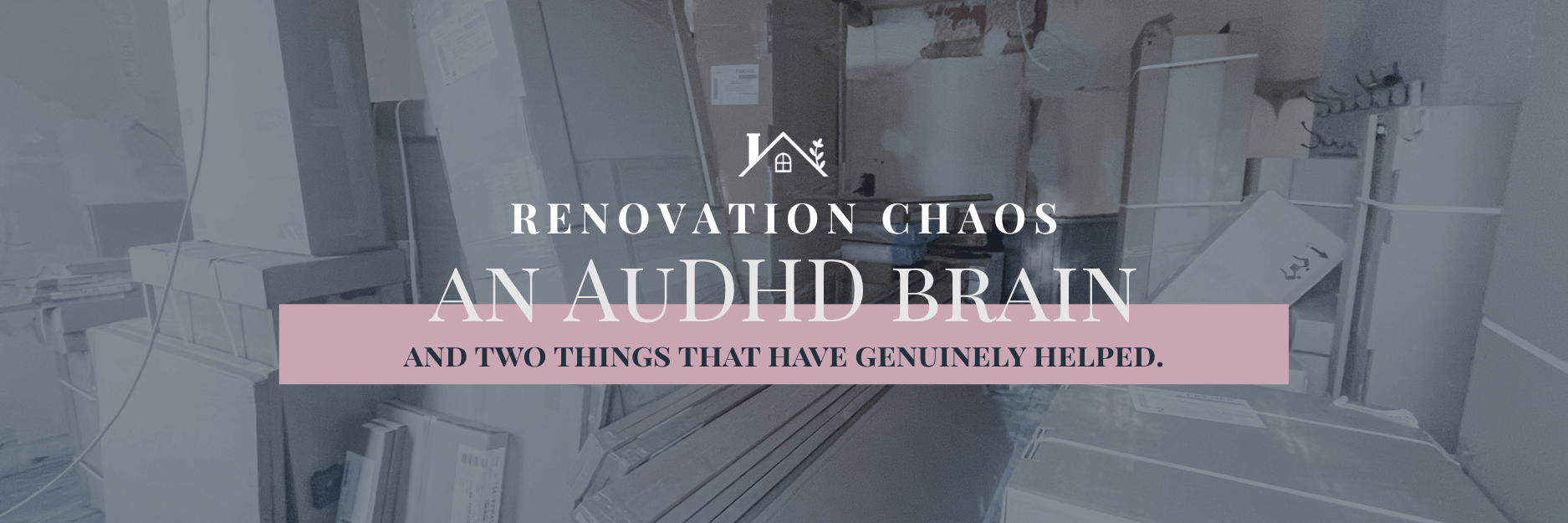
I’m currently standing in the chaos that is our ‘kitchen’. The floor is still to be levelled and laid, and the kitchen is due to arrive next week. I’m beginning to wonder why I decided that documenting our Victorian farmhouse renovation and rebranding was a good idea! So many women are reaching their 40s and 50s, getting diagnosed with ADHD and/or navigating menopause — and realising they can’t keep living the way they always have… so they start again. Sound familiar?
The community I built with ADHD Menopause and Me has been amazing. My account was initially set up to support me and my kids through some pretty tough years. We went from a ‘typical’ family to an ND family with diagnoses of Dyslexia, Delayed Processing, ADHD and now Autism. All in the space of 5 years. I was trying to navigate menopause and raise awareness, but I couldn’t understand why I found it so hard. Walking alongside my boys through their diagnosis journeys taught me something unexpected. I was neurodivergent too. Suddenly, a lifetime of feelings I couldn’t explain began to make sense.
My journey looks different now. The boys are older, and life has shifted. But you are still here — and that means everything. I can’t wait to share this next chapter with you.
How We Got Here
Our youngest’s move to secondary school was, in a word, hard. What we’d hoped would be a fresh start quickly revealed itself to be something more significant. His struggles were deeper and more complex than any of us had fully understood.
Over the years that followed, getting him into school at all became the daily battle. Alongside the dyslexia and ADHD we already knew about, it became increasingly clear that he was also autistic with a PDA profile. Once we understand that, so much of what had felt confusing suddenly makes sense. But his difficulties at school were almost secondary to what was happening socially. Too trusting, too easily led, and younger than his years in ways that weren’t always visible on the surface. I watched him begin to form friendships that worried me. Find himself in situations I couldn’t always protect him from.
It was a lot. For him, and for all of us.
At the same time, life was shifting in other ways. Our two eldest had flown the nest, and for the first time in years, there was space. Space to breathe, to think, and to ask what came next. More than a decade earlier, we had built our first home from the ground up, and that itch had never really gone away.
So we made a decision. A deliberate, wholehearted one. We would move somewhere rural, somewhere slower, somewhere that might give Sam a genuine fresh start in an environment that actually suited him — and give us a new project to pour ourselves into, while still being a home our boys could always come back to.
What How Felicity Finds is now
If you’d asked me a year ago what this space was going to become, I’m not sure I could have told you. But standing in the middle of a half-finished Victorian farmhouse in North Yorkshire, covered in renovation dust with an ADHD brain running at full speed and a body doing its best impression of a malfunctioning thermostat, it became pretty clear.
How Felicity Finds is the honest version of this chapter.
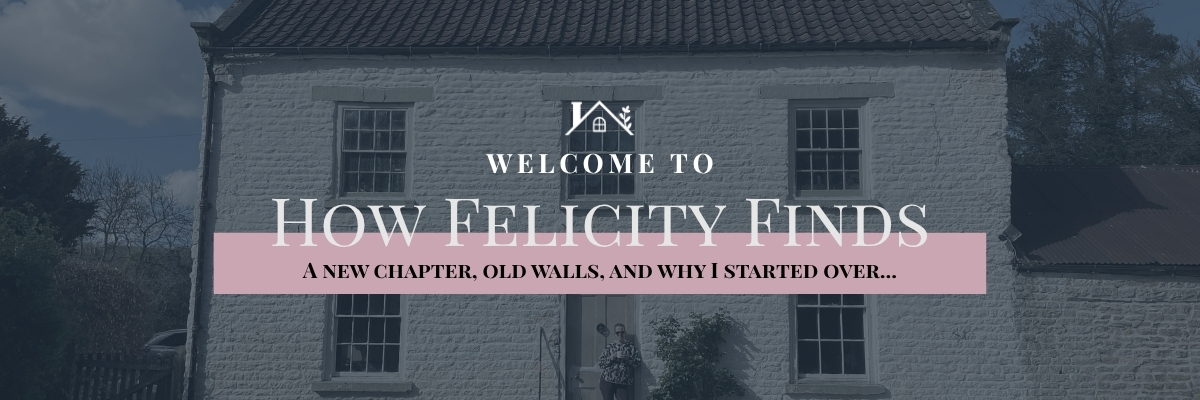
It’s the farmhouse — Hall Farm, Victorian, Grade II listed, full of original features and full of renovation challenges I absolutely did not anticipate. I’ll be sharing every step of the restoration here, the wins, the disasters, the moments where we question every decision we’ve ever made. And of course, the ones where we look at an original sash window and remember exactly why we did this.
It’s the village — Thornton-le-Dale is the kind of place you move to and immediately wonder why you didn’t do it sooner. The beck, the countryside, the slower pace of it all. I want to share what rural life actually looks like when you swap a village just outside the busy city of York for somewhere with a slower pace, woodland in your back garden and the North Yorks Moors on your doorstep.
It’s the ND life — I’m AuDHD and menopausal and a mum to three boys who each come with their own version of complex, and I’m not going to pretend any of that is straightforward. The real talk about neurodivergence, perimenopause, and parenting ND kids stays, because it’s part of every single day here, and it deserves to be spoken about honestly.
And it’s the finds — the things that actually help. Products, tools, places, services that make life in this particular messy, beautiful chaos a little more manageable. Always honest, never just because I’ve been asked.
If you’re a woman in your forties navigating a big life change — or dreaming of one — and you want company that doesn’t pretend it’s easy, you are absolutely in the right place.
What’s coming…
I have a lot planned, and for once, the ADHD hyperfocus is working entirely in our favour.
Every Friday, I’ll be posting a Farmhouse Friday update — one room, one decision, one honest account of where we are with the restoration. We’re starting with the bathroom, which is the one space we’ve actually finished, and working our way through the rest of the house in real time. No staged reveals, no waiting until it’s perfect. You’re getting it as it happens.
I’m also putting together a proper guide to Thornton-le-Dale — the walks, the places to eat, the things the locals know that don’t make it onto any tourist website. If you’ve ever thought about making a move like this, I want that guide to be the thing that helps you imagine it for yourself.
And the AuDHD and menopause content isn’t going anywhere. In fact, I’ve got a post coming that I’ve been wanting to write for months about what executive dysfunction actually looks like when you’re also trying to manage a renovation, a family, and a rebrand simultaneously. Spoiler: it looks exactly as chaotic as you’d imagine.
The best way to keep up is to follow along on Instagram at @how_felicity_finds, or subscribe below to get new posts straight to your inbox. No spam, no schedules — just a new post when it’s ready.
This is a new chapter. The walls are old, the floors are (mostly) original, and I am very much a work in progress — but that’s rather the point.
I originally wrote this post back in April 2023, and I can’t believe how much has happened in 3 small years, and how I’m pretty much back to square one again. Back in 2023, I was looking at senior school places for Sam and possibly full-time work for me. Little did I know that it would be the start of the hardest years both Sam and I have been through, and that, far from being settled in full-time work, I am back to job hunting and still trying to find an educational setting that suits Sam. So are there such things as ADHD jobs? Jobs that are more suited to our ND brains.
ADHD Brains
ADHD brains are very different from neurotypical brains. Attention deficit hyperactivity disorder (ADHD) is a neurodevelopmental condition that causes differences in the brain related to attention, behaviour, and activity levels, including impulsivity and hyperactivity. Researchers are learning more and more about brain development and ADHD. In fact, research has shown that individuals with ADHD may have areas of the brain that mature more slowly or have different activity levels than a neurotypical brain. Some brain differences may change as a child matures.
Many individuals with ADHD have spent a lot of their lives being told that they are somehow not good enough, or ‘deficient’. Women in particular may have spent all their childhood and a lot of their adulthood undiagnosed, wondering why they have never fully achieved the potential they know they have. It’s so important to realise that ADHD has many positive traits. And actually, employers nowadays are actively seeking our natural talents and personality characteristics.
What we have to offer!
Individuals with ADHD have the following amazing traits:
Enhanced creativity and imagination
Greater resilience
Compassion and empathy
Greater problem-solving abilities
Talents for multitasking
The willingness to help or mentor others
An enhanced capacity for leadership
Positive, people-oriented interpersonal skills
Greater adaptability
Higher energy
Now you know how amazing you really are, so start thinking about what type of job you might like, or what might suit your specific skill set and traits. There are definitely some jobs that are suited to those with ADHD.
ADHD Friendly Jobs
So just what types of jobs should we be looking at? A main consideration should, of course, be what you are passionate about! We all know that we need to stay interested to keep motivated. That said, the creative, engaging, and interactive professions listed below make the most of ADHD traits such as empathy, energy, enthusiasm, and hyperfocus.
Teacher / Early Years Practitioner / SENDCO
Journalist / Copy Editor / Graphic Designer
Artist / Actor / Stage Manager
Chef / Restaurant Manager
Beautician / Hairstylist / Stylist
Police / Fire Services / Paramedic / Nurse
Computer Technician / Software Developer
Small Business Owner / Entrepreneur
A survey twenty years ago (2003) commissioned by BBC2 for Mind of a Millionaire, found evidence that 40% of entrepreneurs are likely to be neurodivergent, four times the national average. More recently, studies have found that individuals with ADHD are significantly more likely to become entrepreneurs.
Moving forward – Living with ADHD
So there we have it, there is a myriad of ADHD-friendly jobs out there for us, we just have to figure out which one we want. Then work ourselves up to applying, and somehow get through the interview #NoPressure. For me, there is still a lot of thinking to do. I love my current job and love who I work with, but I’d like to work more hours and have more flexibility. The thought of entering the job market again is causing me anxiety, though. Is it worth it?
I’d love to hear from any other women out there who have changed careers or jobs after being late diagnosed with ADHD. How did you find it? Did you relish the change?
Intrusive thoughts are a common symptom of Obsessive-Compulsive Disorder (OCD) and Attention-Deficit/Hyperactivity Disorder (ADHD). However, they can also be triggered by menopause. But what exactly are negative thoughts, why do we get them, and what do they mean?
What are Intrusive Thoughts?
Intrusive thoughts are distressing and unwanted thoughts, images or urges that suddenly pop into your mind. They can be very varied, but usually take the form of:
Doubts: “What if my baby stopped breathing?” “What if I shook the baby?”
Images: The image of the house burning down because the hair straighteners were not switched off.
Impulses: Urge to crash into the car in front of you, urge to hit your baby when they won’t stop crying.
Thoughts: “The kitchen surfaces must be disinfected before I cook”, “Everything must be in the right place before I leave the house.”
ADHD & Intrusive Thoughts
Having an inattentive brain can make us vulnerable to experiencing obsessive and repetitive thoughts. People with the Inattentive Type of ADHD often find their minds wandering elsewhere and forget what they are doing or where they are going. In contrast, the thoughts of a hyperactive ADHD brain may be more aggressive or intrusive than those of a neurotypical brain.
Since the body experiences vital hormonal changes, menopause directly impacts mental and emotional well-being. Intrusive thoughts can become commonplace during menopause as hormone levels are falling. This can lead to feelings of worry, fear and sadness, which can cause distress. Night terrors can also become commonplace. Some women also feel suicidal, but often without feeling the need to act on it.
My Story
It’s still rarely talked about due to its darker nature. Consequently, many of us believe we are alone in these thoughts, which exacerbates feelings of shame and guilt.
My earliest memory of intrusive thoughts was as a teenager. I remember thoughts would just come into my head about harming others, about being raped, and about harming myself. I had no idea what these were and was so ashamed that I never mentioned them to anyone.
When I became a mother, and my PND (now known as undiagnosed ADHD) was at its worst, the thoughts returned and were very much based around my boys and harm to them, or my ability to be a mother and why I should be there.
A recent study of new mothers showed that 100 per cent of new mums had worrying thoughts about their baby being harmed accidentally, and 50 per cent had worrying thoughts about harming their baby in some way. These thoughts were the most worrying for new mums.
When menopause hit, the intrusive thoughts returned with a vengeance. Thoughts of driving the car at speed into the middle barrier, suicidal thoughts, and thoughts about my boys being harmed or killed when they were out were all commonplace at one point.
Why Do Intrusive Thoughts Happen?
The exact reasons why intrusive thoughts happen are still being researched, but there are a few main theories:
Misfiring Brain Circuits: One theory suggests that intrusive thoughts might be caused by temporary glitches in the brain circuits involved in processing thoughts and emotions. These misfires could lead to unwanted thoughts popping into your head.
Evolved Defence Mechanism: Another theory proposes that intrusive thoughts might be an evolutionary leftover. Perhaps they stem from a primal urge to identify and avoid potential dangers. However, in the modern world, these thoughts can become exaggerated or irrelevant, causing distress.
Attention and Anxiety: Obsessive thoughts can also be linked to how we pay attention. When we focus on avoiding a particular thought, it can ironically make it more likely to appear. Additionally, anxiety and stress can make us more aware of our thoughts, amplifying the presence of intrusive ones.
What Do Intrusive Thoughts Mean?
Intrusive thoughts themselves don’t necessarily have a deep meaning. They are simply unwanted thoughts, images, or urges that pop into your head and can be quite disturbing or upsetting.
Here’s what intrusive thoughts don’t mean:
They don’t mean you’re a bad person: Having these kinds of thoughts doesn’t reflect your morality or character. Most people experience them, and the content itself doesn’t define you.
They don’t mean you’ll act on them: The overwhelming majority of people with intrusive thoughts never act on them. The thoughts are distressing precisely because they go against your values.
For me, getting my sleep sorted, getting the right HRT sorted, and trying to reduce the stress in my life have helped enormously. Although recently I’ve noticed a return. For me, though, the biggest help is knowing that they are not a reflection of me personally and that I’m not alone.
Do you suffer from? How do you deal with it?
Fay x
NB: If intrusive thoughts become overwhelming or significantly disrupt your daily life, please seek professional help.