Tag: Yorkshire farmhouse renovation

  • Farmhouse Friday #2 — the kitchen arrived. We were not ready.

    Farmhouse Friday #2 — the kitchen arrived. We were not ready.

    Disclosure: this post contains affiliate links. If you purchase through my links I may earn a small commission, at no extra cost to you. I only ever recommend products I use and genuinely believe in.

    I’d planned the kitchen renovation down to the tee. Spent hours/days (yep, really!) measuring, re-measuring and planning the kitchen by myself. We’d known for over a month what week it would arrive. So, of course, sods law we had no workmen here the week before. My husband was away playing in a squash tournament. The kitchen floor hadn’t been prepped, and it arrived a day early!

    When we bought the house, the kitchen was still quite intact. However, it was quite modern, and not at all what would be found in a Victorian farmhouse. We were able to remove all the units, but there is a small cupboard at work surface height, which was located in the corner of the kitchen. This cupboard is listed, so has to remain. It has been the hardest part of the kitchen renovation to design around, and I’m still worried it may throw us a curveball.

    Victorian farmhouse kitchen renovation

    We’ve gone for a shaker style kitchen, with range cooker (from our previous house), kitchen island and integrated appliances. It is more of a simple modern shaker style than our previous kitchen. But still in keeping with the farmhouse. There will be some open shelving in the utility and boot room, but we’ve yet to decide on worktops… and flooring…

    We were obviously hoping to have the flooring ready so could have put the floor units ‘in place’ as they arrived. But, that wasn’t to be. The delivery guys were great and so accommodating. They kept the three deliveries (Kitchen, Boot Room & Utility) separated when storing in the dining room. This should hopefully help the kitchen fitter as he starts on the kitchen next week.

    On weeks like this one, I’m especially grateful for Rebel Rituals — the hormonal chaos of perimenopause and ADHD, on top of renovation stress is its own particular kind of overwhelming. Having something that takes the edge off the symptoms makes the rest slightly more manageable.

    Victorian farmhouse kitchen renovation

    So finally this week, the kitchen was cleared, the underfloor heating matting went down and the screed went down to level the floor. Ready for the kitchen fitter on Tuesday. Floor tiles will go down after the units are in place. We also have to choose our worktop which I’m really undecided about. I really wanted wooden worktop, but I understand the hubby’s concern about burn/scorch marks from hot pans etc.

    So make sure you save this post and come back for Farmhouse Friday #3 — the kitchen goes in. This next week is going to bring such a big change in the house. If you are new here, then check out what’s happened so far with our Victorian Farmhouse renovation journey. And follow me on Instagram for real-time updates.

  • Farmhouse Friday – Family Bathroom

    Farmhouse Friday – Family Bathroom

    Introducing my brand new series of Farmhouse Friday, where I’ll share a specific room within the house, and what’s happened this last week. The first room of the series is the family bathroom, which is pretty much done. It’s not been without its challenges; a Victorian farmhouse bathroom isn’t always straightforward. So check out the before and after, and how we managed to do this for less than £2.5k! I will caveat from the outset that the wall panels we used were kindly #gifted from Multipanel.

    Farmhouse Friday - Victorian farmhouse bathroom before and after (4)

    The room itself isn’t small as such, but does come with some limitations. It was originally part of a much larger room, hence the stunning, large window. However, this doesn’t immediately lend itself to a bathroom. Not only that, but it is long and thin, making it difficult to change any layout with great effect. And let’s not mention the 70’s pine cladding…

    Originally, there had been a bath, basin and toilet, and the layout wasn’t going to change. However, with 3 boys, we wanted to go for a large shower, rather than a bath. I also knew this would probably be the most used bathroom, so it needed to be easy to keep clean, too!

    A monochrome bathroom to me is timeless, and perfect to pick up/refresh with simple highlights if wanted. I did feel it would be very stark on its own, and so wanted to ensure some greenery was added to soften the look. The renovation itself was fairly straightforward, although we did come across a few hiccups.

    • The layout was already there, so no major work was required.
    • The window added a fantastic amount of natural light.
    • The panelling was pretty easy to install and went up in a day.
    • There was a small misunderstanding around the wall-hung basin, which means the plumber had to cut out the panelling once it had been installed. He very kindly cut out along the ‘grout’ of the tiles, so once back in place, it should be unnoticeable.
    • The window gives no privacy at all.

    Here is the breakdown of exactly how much the restoration cost and where we sourced everything from.

    Wall Panels – Multipanel UK – Alpine White Metro Collection (Very kindly #gifted) – P.O.A

    Floor TilesAmazon #Aff – £127.60

    Traditional Concealed ShowerVictorian Plumbing – £249.95

    Shower Tray & Screen Victorian Plumbing – £539.95

    Wall Hung BasinVictorian Plumbing – £129.95

    Traditional Wall Mounted TapsVictorian Plumbing – £139.95

    Traditional Low Level ToiletVictorian Plumbing – £299.95

    Soft Close Toilet SeatVictorian Plumbing – £79.95

    Traditional Style RadiatorVictorian Plumbing – £419.95

    Wall LightsDunlem – £64 (£32 each)

    Mirror B&M – £8

    ShelfB&M – £5 (have linked longer size for online, but shorter length available in store)

    Japanese ScreenAmazon #Aff – £89.99 The perfect solution to the privacy issue!

    Plants – My own

    Wooden Storage Unit – My own

    Shower WasteVictorian Plumbing – £37.95

    Basin Waste & Bottle TrapVictorian Plumbing – £89.95


    So, there we have it. The first of our Farmhouse Friday series, and a deep dive into our Victorian farmhouse bathroom before and after. If you have any questions, then please just ask, and I’d love to know if you like?!

    Would you consider using wall panels instead of tiles?!

  • How to Create a Moodboard for a Home Renovation Using Pinterest and Canva

    How to Create a Moodboard for a Home Renovation Using Pinterest and Canva

    Planning a home renovation can feel overwhelming — especially when you’re renovating a character property or listed building, where every decision matters and changes can be costly. One of the simplest ways to bring clarity to your ideas before the dust, disruption and design decisions begin is to create a moodboard.

    Using Pinterest to gather inspiration and Canva to pull it all together, you can create a clear, visual direction for your renovation or room trannformation — without needing a designer or expensive software.

    I love a good moodboard, here’s how I easily get my ideas out of my head and onto paper.

    When renovating a period or listed property, it’s easy to fall into one of two traps:

    • Playing it too safe and losing character
    • Mixing too many styles and ending up with a confused space

    I find a moodboard helps ensure you strike a balance.

    It allows you to:

    • Visualise the finished space before committing
    • Keep character and history front of mind
    • Make confident decisions on paint, materials and finishes
    • Communicate your vision clearly to trades and suppliers

    Think of it as your renovation compass — something to return to whenever decisions feel hard. I quite often find I’m still updating/tweaking as the journey moves on and I learn more about the building.

    how to create a moodboard for a room transformation

    Pinterest is your starting point for exploration.

    Instead of something vague, be specific:

    • Victorian Farmhouse Living Room Moodboard
    • Listed Building Kitchen Renovation
    • Neutral Country Bedroom Ideas

    This helps Pinterest serve you better suggestions — and keeps your ideas cohesive. You can then break it down into sections within that board. I did this to keep all the bathrooms together, but then had a section for each specific bathroom. You could also use to split out flooring from lighting etc. Whatever works best for you.

    At this stage, don’t analyse too much. Pin anything that:

    • Stops you scrolling
    • Feels like the atmosphere you want
    • Includes colours, textures or layouts you’re drawn to

    Look for:

    • Whole rooms
    • Close-ups of finishes
    • Architectural details
    • Lighting styles
    • Flooring Styles

    Aim for 25–40 pins initially.

    This is where the magic happens.

    Go back through your board and remove anything that:

    • Feels trendy rather than timeless
    • Doesn’t suit the age or character of your home
    • Clashes with the overall mood

    Patterns will start to emerge — similar tones, materials, layouts or styles. That’s your direction revealing itself.

    Before you open Canva, take a moment to get clear on the big picture.

    Ask yourself:

    • Is this space warm or light?
    • Rustic or refined?
    • Traditional with modern touches?

    Most renovation moodboards come down to:

    • 2–4 core colours
    • 1–2 dominant materials
    • One clear overall feeling

    You’re not choosing exact products yet — you’re defining the vibe.

    Canva is perfect for turning inspiration into something tangible.

    Search Canva for:

    • “Interior moodboard”
    • “Collage”
    • Or use a blank A4 or square canvas

    Simple layouts work best, especially for renovation planning.

    how to create a moodboard

    Download your favourite pins and upload them to Canva.

    Tips for arranging:

    • Mix wide shots with close-up details
    • Group similar tones together
    • Leave breathing space — less is more

    Your board should feel calm and intentional, not busy.

    This is what transforms a moodboard from inspiration to a working tool.

    Use Canva’s shapes to add swatches representing:

    • Wall colours
    • Wood tones
    • Accent shades

    You can sample colours directly from images using Canva’s colour picker.

    Light, minimal text works well:

    • “Warm neutral walls”
    • “Natural timber throughout”
    • “Soft aged brass finishes”

    This is especially helpful if you’ll be sharing the moodboard with trades or suppliers. You can also play around with Canva’s elements if you want to add graphics such as arrows, or in my case, a paint ‘splodge’ to help really bring the paint colours to life.

    Step away and come back later.

    Ask yourself:

    • Does this feel cohesive?
    • Does it suit the age of the property?
    • Will I still love this in five years?

    If something feels off, tweak it. Moodboards are meant to evolve — just like renovations. Quite a few of mine are still being tweaked now, as my ideas develop.

    A renovation moodboard isn’t about having all the answers — it’s about creating confidence.

    Using Pinterest and Canva together gives you:

    • Direction without pressure
    • Inspiration without overwhelm
    • A clear vision to guide every decision

    If you’re renovating a home with history, this step is invaluable. It keeps the soul of the house intact while making it work for modern life.


    👉 If you’re mid-renovation, you’ll find more moodboards, real-life decisions and honest progress over on my renovation playlists on YouTube — don’t forget to subscribe so you don’t miss what’s next.

  • Hall Farm Come Inside Our Grade II Listed Farmhouse

    Hall Farm Come Inside Our Grade II Listed Farmhouse

    Before we bought our Grade II listed Victorian farmhouse, we had just 10 minutes to look around.

    No second viewing.
    No measuring.
    No time to fully process what we were taking on.


    That short window became the moment we decided whether to buy the house that’s now our biggest project yet.

    I’ve shared a walkthrough in my latest YouTube video in roughly the same amount of time, to give you an idea of just how little time we had! It’s a little raw in places (all my proper filming equipment is currently in boxes somewhere), but it captures the reality — the unknowns, the nerves, and the spark that made us say yes anyway.

    Since then, the progress over the last few weeks has been incredible — and we’re now just weeks away from finally moving in.

    If you’re interested in property, renovation, heritage buildings, or the reality of taking on a long-term project alongside full-time work and family life in video, then subscribe to the YouTube channel. It will give you a great insight as our journey progresses!

    🎥 Watch the video above

    Sometimes the biggest decisions really do happen in the smallest windows of time.


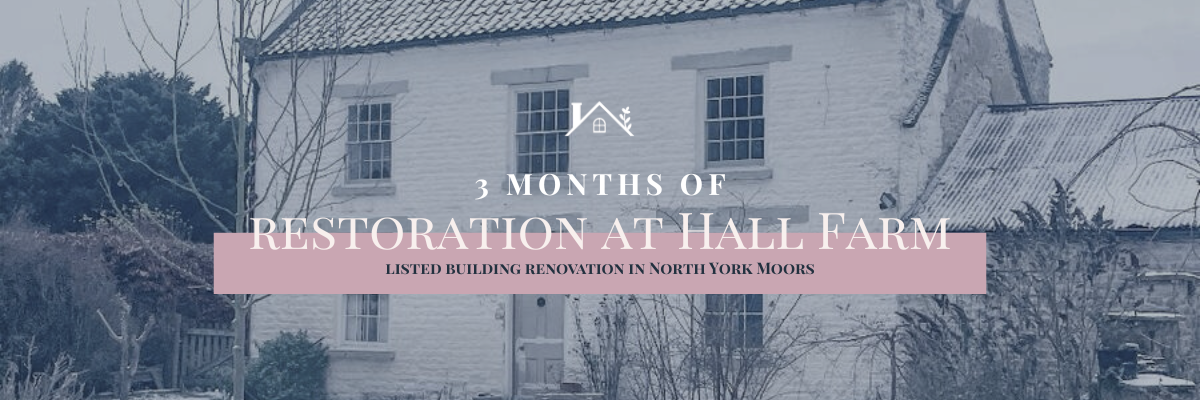
  • 3 months of Restoration at Hall Farm: Listed Building Renovation in Yorkshire

    3 months of Restoration at Hall Farm: Listed Building Renovation in Yorkshire

    As a new year begins, we’ve found ourselves looking back at just how much has changed at Hall Farm over the past three months. Owning a listed building in the heart of Thornton-Le-Dale, Yorkshire, has always felt like a privilege, and these last few months truly marked a turning point in our renovation journey. What once felt like an endless to-do list has slowly transformed into real, tangible progress.

    Much of the work completed so far hasn’t been the glamorous, Instagram-ready kind — but it has been essential. We began by completely rewiring and replumbing the house, carefully threading modern infrastructure through centuries-old walls. These upgrades were designed to future-proof Hall Farm. Ensuring it remains safe, efficient, and comfortable, while respecting its historic fabric.


    Alongside this, we installed a brand-new boiler — a small miracle for anyone who has lived through a Yorkshire winter in a draughty old farmhouse. The chimneys have been inspected, made safe and will be restored fully this year. It has made an enormous difference to daily life here.

    Some of the most satisfying moments came from restoring what was already here. We have spent weeks dipping, sanding and waxing the original doors and windows, bringing their character back to life. The last of the windows will be refitted this month. The same goes for the original beams, which were carefully sandblasted to reveal their age, texture and history — a reminder of just how many stories these timbers have held.

    The kitchen, once dark and impractical, was completely ripped out. While it’s still very much a work in progress, clearing the space felt symbolic — making room for something new while honouring what came before.

    Perhaps the most traditional craft we embraced this year was lime plastering. Messy, slow and incredibly rewarding, it has helped the house breathe again. As well as reinforced our commitment to sympathetic restoration rather than quick fixes.

    When we stand back now, Hall Farm feels healthier, stronger and more itself than it has in decades. There’s still plenty to do, but this year laid the foundations — literally and figuratively — for everything to come.

    If you’d like to follow along as we continue restoring this little piece of Yorkshire heritage, we’d love you to subscribe and join us for the next chapter.